The name
The Dagda is the chief of the Tuatha Dé Danann, the gods of pre-Christian Ireland. His name means the good god — not good in the moral sense, but good at everything: a father-figure, a king, a warrior, the keeper of a cauldron that never empties and a club that could kill with one end and restore life with the other. He is the figure the other gods look to.
The chief of the gods is a fitting name for the car at the top of the lineup, and that is the whole reason for it. Dagda is the name we saved for the car that needed the biggest one.
What the summit means
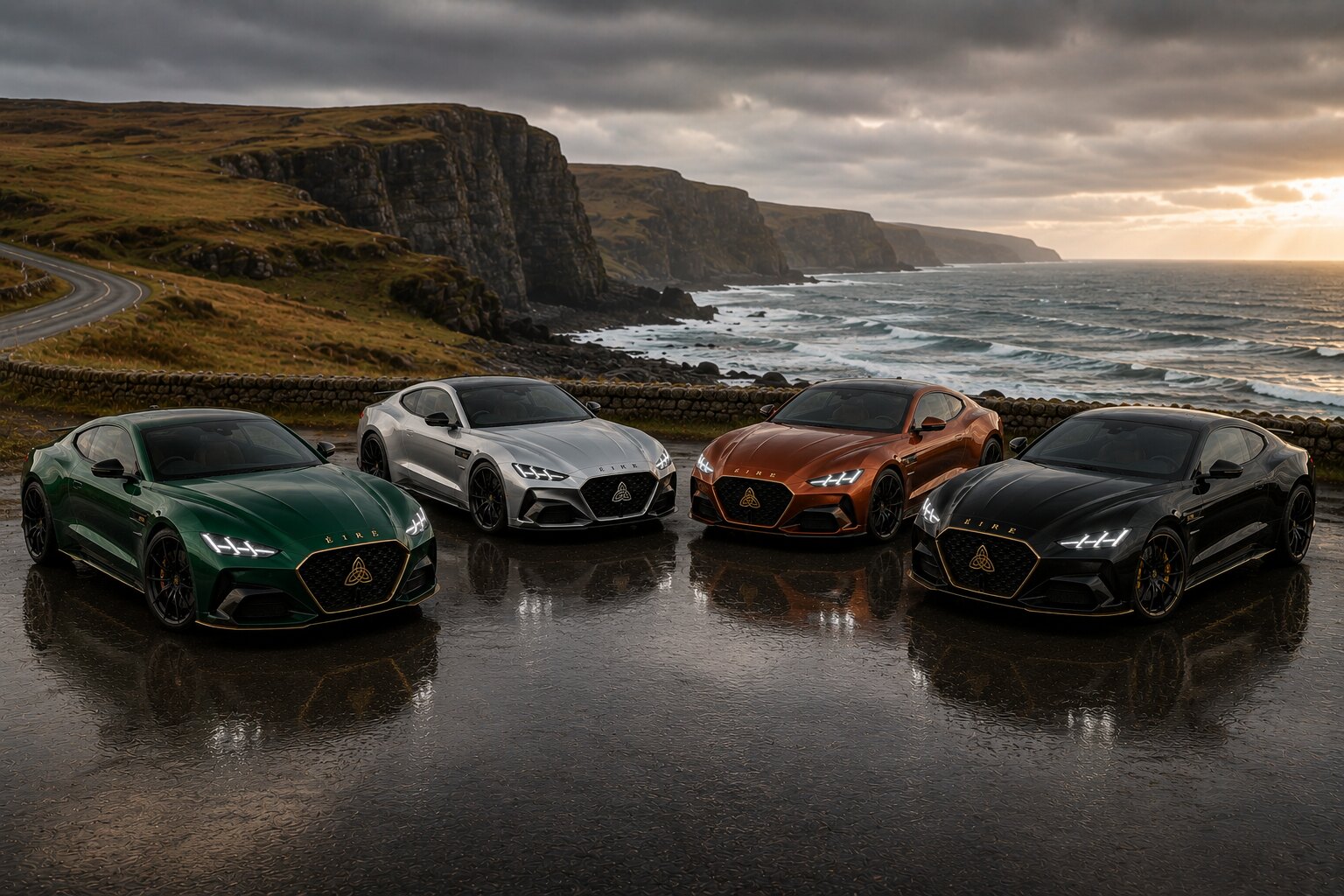
The Éire family is a ladder, and each car earns the next. The Forge is the laboratory. The Eden GT is the first car customers can buy. Balor widens the family. The Banshee is the exotic. Dagda is the car above it.
It is the hypercar: the one vehicle in the lineup that receives the platform's full potential, with nothing held back for a car above it because there is no car above it. Everything the other cars learn, every restraint they practise, is in service of this one. That is what we mean by the summit. Not the most expensive car, not the loudest. The complete one.
The heart
Dagda's engine is a bespoke twin-turbo V10 hybrid. Bespoke means what it says: its own engine, designed for this car, not a V8 from the rest of the family with two more cylinders bolted on. It is the only V10 in the lineup, and it is there because the summit deserves a voice of its own above the three V8s. The Eden GT rumbles, Balor roars, the Banshee screams. Dagda is a different instrument.
The V10 is paired with three electric motors and torque vectoring. Three motors means the electric side can do more than fill in torque — it can decide, wheel by wheel, where the car's effort goes, and it can do that faster than any mechanical differential. Torque vectoring is what turns that decision into steering: more drive to the outside wheel in a corner, less to the inside, the car rotated by power rather than only by the wheel in the driver's hands.
Why a V10
Because of the voice, first. The three V8s in the family already cover a great deal of ground between them — the Eden GT's cross-plane thunder, Balor's harder version of it, the Banshee's flat-plane scream — and a fourth V8, however extreme, would have been a variation on a theme. A V10 is not. Ten cylinders make a sound that sits somewhere between a V8's weight and a higher-revving engine's urgency, a note that has belonged to the top of motorsport for a reason, and it is a sound none of the cars below Dagda can make.
And because of what the summit asks. Dagda is the one car that receives the platform's full potential, and the engine at the centre of that has to be designed for the job from a clean sheet rather than adapted from a car with a different purpose. A bespoke engine is more work by a wide margin. It is also the only way to build the car we have described, and Dagda is not a car for shortcuts.
The Éire Continuous Torque System
This is the technology pillar we have named for Dagda, and it is the idea we care about most. The principle is simple to state: repeatable deployment over headline numbers.
Hypercars are usually described by a peak. A peak output, a peak speed, a peak that arrives once under perfect conditions and is quoted forever after. We are not interested in building a car whose best moment is a number on a page. What we want from Dagda is that it gives you its full self on the tenth lap as freely as on the first — that the electric side is managed for sustained deployment, that the thermal systems are sized for repetition rather than for a single run, and that the car you drive at the end of a session is the car you drove at the start of it.
That principle runs through the whole family. It is why Balor keeps a protected performance reserve. In Dagda it is the organising idea, the thing the engine and the motors and the software are all built to serve. Continuous torque is not a feature. It is the standard.
What the other cars teach it
Dagda is last in the ladder for a reason: it is the car that benefits most from everything learned before it. The Forge teaches the marque how a battery, a cooling system and a control stack behave on a real chassis, in the open, where mistakes are cheap. The Eden GT teaches it how a serious electric side and a serious engine share the work so smoothly that the driver stops noticing the hand-off. Balor teaches it how to protect a performance reserve so that a hybrid never goes soft. The Banshee teaches it how an electrified front axle changes the way a mid-engine car leaves a corner.
Dagda takes all of that and adds a third motor and the vectoring that three motors make possible. None of it would be trusted on the summit if it had not been proved lower down. That is what we mean when we say each car earns the next, and it is why the order of the family will not change even as everything else about it does.
The design
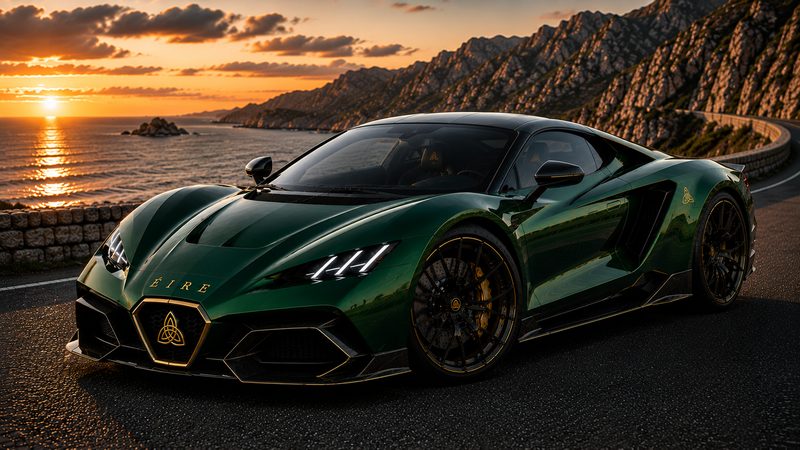
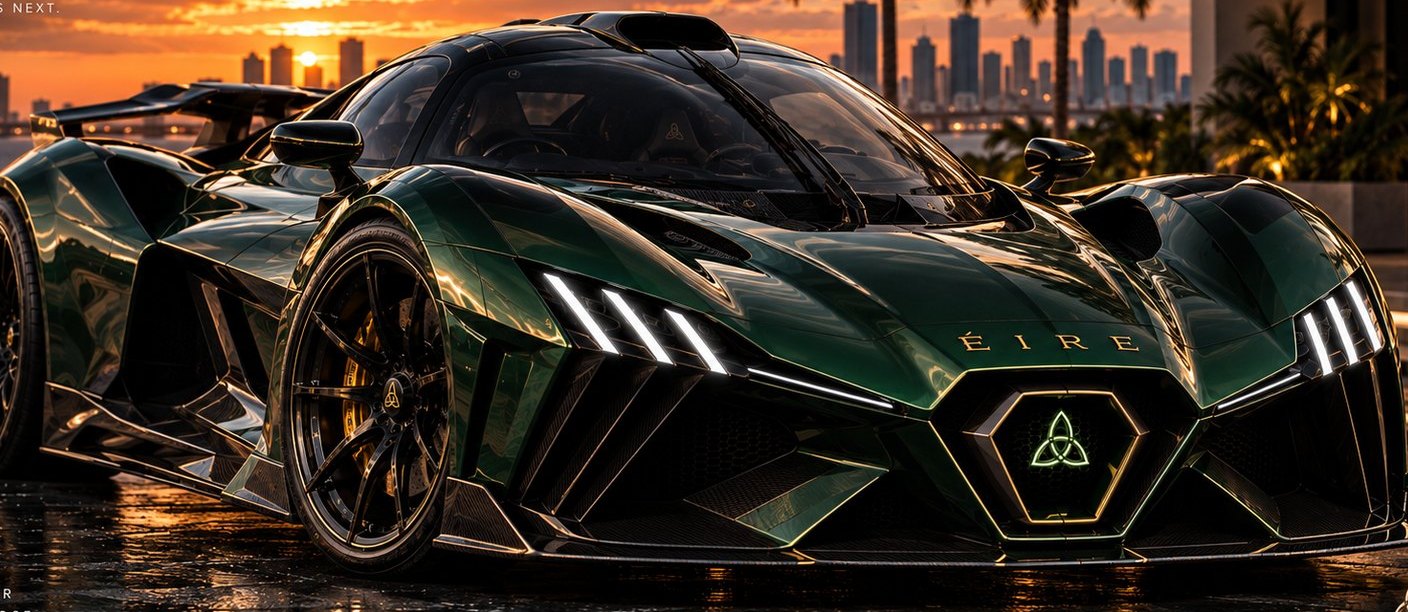
The renders show the family's DNA taken to its limit. The three-blade lighting signature, the emerald honeycomb grille with the copper trinity knot, the emerald paint and the copper details are all present, stretched over a low, wide, mid-engine form whose every surface exists to manage air. The rear is dominated by the wing and the diffuser because at this level the car has to be. The front is dominated by the face because it is an Éire.
It is the most extreme shape we have drawn, and the test we set for it is the same test we set for every car in the family: from across a car park, would you know whose it was? We think you would. The poster line for the car — a higher kind of power — was written before the design was finished and we have not found a reason to change it.
Strictly limited, individually numbered
Nothing about how many Dagdas will exist, or when, is decided. It is the furthest car from today, and we would rather say that plainly than dress it up. We will not say how many, because a concept that quotes a production figure is making a promise it has not earned, and because the number is not the point. The point is that each Dagda will be a specific car with a specific place in the sequence, built for a specific person, and that there will not be many of them.
Where it stands, honestly
Dagda is a concept — a design study, not a product. There is no order book. The specifications that sit behind the renders will change as the study matures, and we will not quote any of them. What we have shown is the idea: a bespoke V10 hybrid, three motors, torque vectoring, and a system built around repeatable deployment rather than a peak.
Everything about Dagda is earned by the cars below it: the Eden GT first, then Balor, then the Banshee. It is the last car we will build in this family, and it will be the one we have prepared for longest. We are showing it now because a ladder needs a top rung for the rest of it to make sense, and because we would rather you saw where the family ends than wondered.
The Eden GT comes first. Dagda is why the Eden GT is worth getting right.