The name
The bean sí — the woman of the fairy mound — is one of the oldest figures in Irish folklore. She belongs to certain families, and when she keens, the family knows. She is never described by how she looks. She is described by how she sounds. For a car whose first job is to be heard, no other name would do.
We chose it knowing it is a name people already think they know. That is fine. What matters is what it means to us: sound before sight, a voice that carries, and a certain unease in the people standing nearby.
What the Banshee is
The Banshee is a mid-engine exotic. The engine sits behind the driver, the cabin sits forward, and the entire car is shaped around a very different set of priorities from the Eden GT. The grand tourer is built to cross a country and arrive wanting more. The Banshee is built for the last twenty miles of that journey, the ones with corners in them.
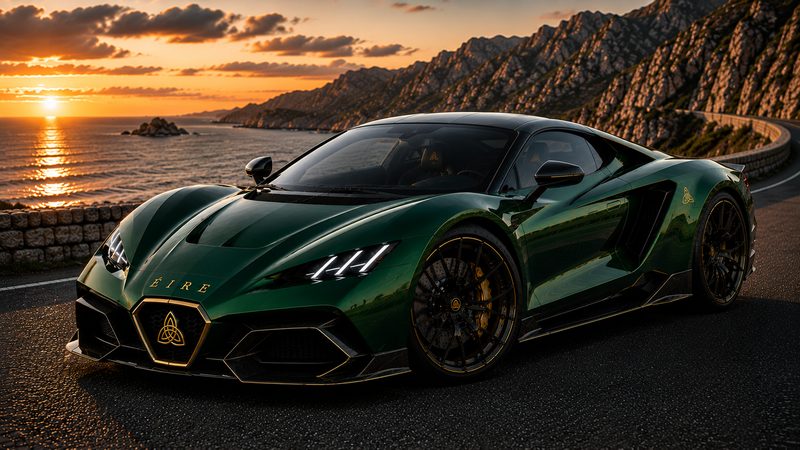
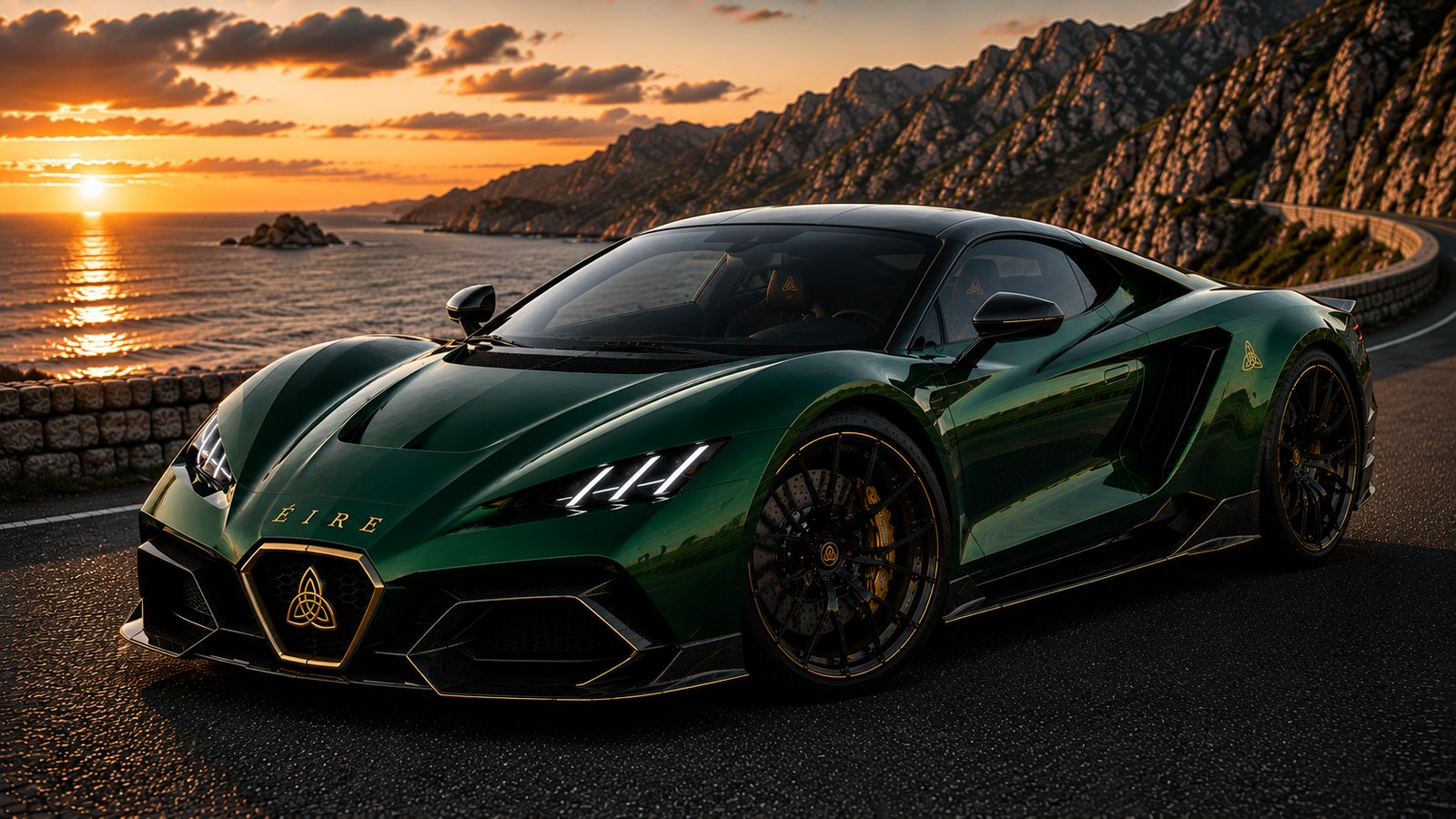
It is still, unmistakably, an Éire. The emerald paint. The copper trinity knot in the emerald honeycomb grille, set lower and wider than on the Eden GT because the nose is lower and wider. The three-blade lighting signature, narrowed to slits. Nothing on it is borrowed from another company's idea of what an exotic should look like. It is our grand tourer's DNA stretched over a very different skeleton.
Why mid-engine
A grand tourer carries its engine in the nose and its passengers behind it, because that layout gives you a long hood, a cabin set back for two people and their luggage, and a car that settles into a fast, stable rhythm on a long road. It is the right layout for the Eden GT. It is the wrong layout for the Banshee, and the reason is where the weight sits.
Put the engine behind the driver and the heaviest part of the car moves toward its centre. The car rotates around the people in it rather than around something ahead of them. Turn-in is sharper, the rear feels planted under power, and the driver sits close to the front wheels with a short view over a low nose. Everything that makes a mid-engine car harder to live with — the luggage, the visibility, the noise a foot behind your head — is exactly what makes it a better instrument for the twenty miles with corners in them. The Banshee accepts that trade without apology. It is the family's exotic, and an exotic that is easy to live with has usually stopped being one.
The third voice
Here is the part that matters most. The Éire V8 hybrids share one family and three voices. The Eden GT's engine is a cross-plane V8, which gives it the deep, uneven thunder that a great American V8 is known for. Balor uses that same cross-plane family, tuned louder and harder. The Banshee is different in kind. Its engine is a flat-plane twin-turbo V8.
A flat-plane crank changes everything about how a V8 breathes and sounds. The firing order is even between the two banks, the exhaust pulses do not tangle, and the engine can rev higher and faster than its cross-plane cousin. The trade is that it loses the low rumble. What it gains is the scream: the high, hard, rising note that racing V8s have always had and that road cars in this segment are built around. That is the Banshee's voice. The Eden GT rumbles. Balor roars. The Banshee screams.
The electrified front axle
The Banshee is a plug-in hybrid, like every V8 in the family, but its hybrid side is arranged differently. The front axle is electric: the front wheels are driven by electric motors while the V8 drives the rear. That gives the car all-wheel traction when it needs it and pure rear-drive character when it does not, and it puts the instant torque of the electric side exactly where a mid-engine car most wants help — at the front, out of a slow corner, before the turbos have caught up.
It also gives the Banshee the same quiet the Eden GT has. Electric-only running for the town, the early morning, the hotel car park. Then the engine wakes up and the whole car changes its mind about what it is for.
Holding something back
This is the part we want to be most honest about, because it runs against the usual way of talking about cars like this. The Banshee deliberately does not use everything the platform can give it.
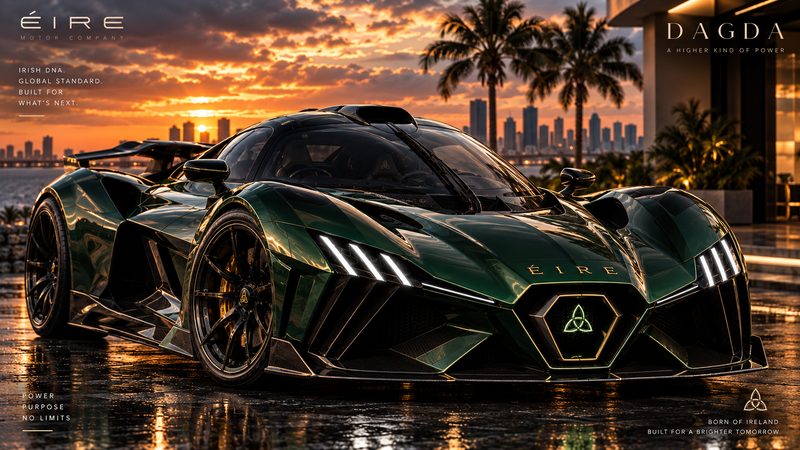
That is not modesty and it is not an accident. There is a car above the Banshee in the Éire ladder — Dagda, the summit — and Dagda is the one vehicle in the family that receives the platform's full potential. The Banshee is complete on its own terms. We would rather build an exotic that is complete on its own terms and leaves the summit to the car built for it than build one that spends everything at once and leaves nothing above it.
That decision shapes the Banshee's character more than any number could. It is the exotic that knows what it is: fast, loud, sharp, and content to be exactly that.
What it shares with the Eden GT
More than the badge. The Banshee inherits the family's hybrid know-how directly from the grand tourer: the way a serious electric side and a serious engine divide the work, the way the car decides when to wake the V8 and when to leave it asleep, the years of learning that go into making that hand-off invisible. All of that is developed on the Eden GT first, where it has to feel natural over a long day, and only then rearranged for a car with the engine behind the driver and electric motors up front.
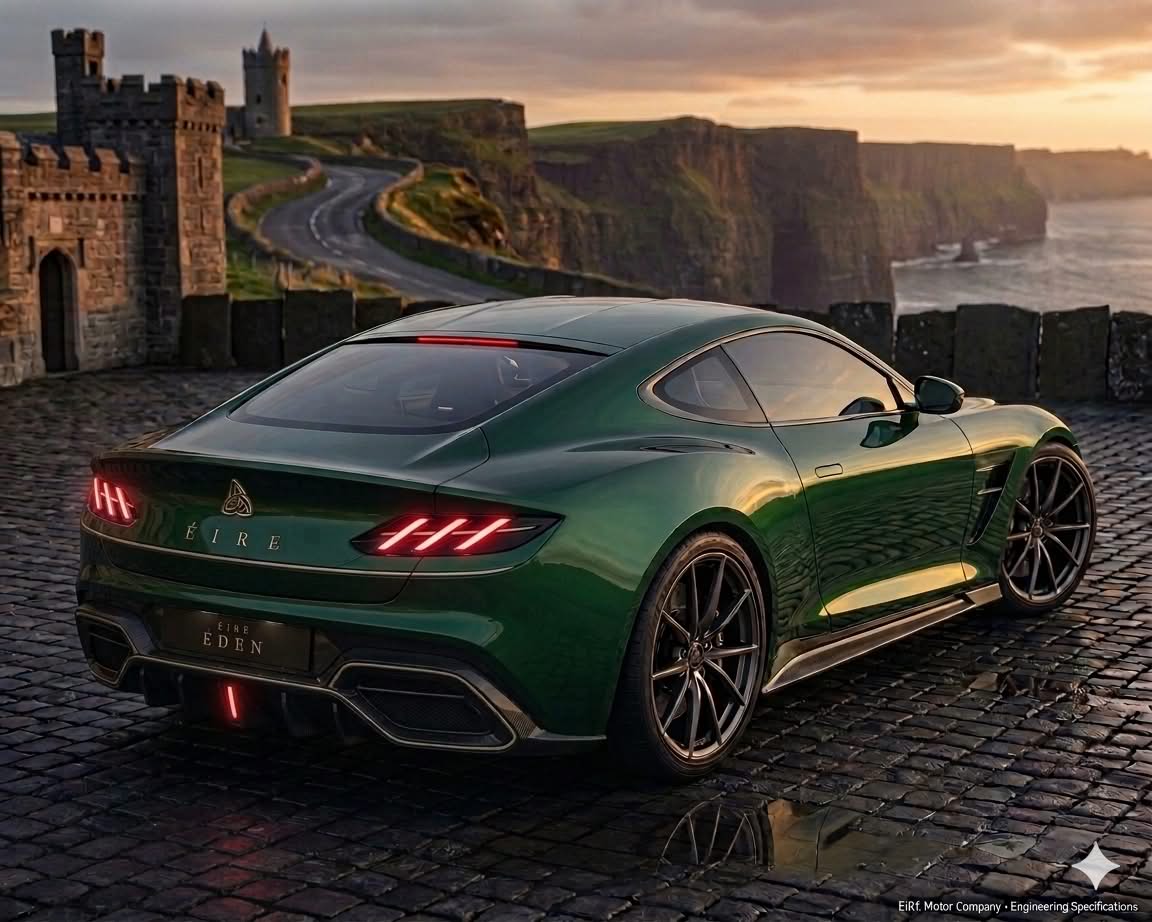
It shares the cabin discipline too. The Eden GT is built around driving — information where the driver is looking, nothing added for show — and the Banshee holds to that with less room to work in and a great deal more going on behind the seats. And it shares the family's honesty about sound. The Eden GT chose a cross-plane crank because it wanted a particular voice. The Banshee chose a flat-plane crank for the same reason. Neither is pretending to be the other, and both are unmistakably ours.
The design
The renders show a low, cab-forward car with its mass carried behind the driver and its surfaces pulled tight over the mechanical package. The proportions are the proportions of a mid-engine car and we have not tried to soften them. What we have done is keep the family's discipline: the honeycomb and the knot, the three blades, the copper used sparingly against the emerald, and a rear that is clearly related to the Eden GT once you have seen them together.
It is the most aggressive shape in the family below Dagda, and it is still, at a glance, ours.
Where it stands, honestly
The Banshee is a concept: a design study, not a product. There is no order book. There are no final specifications, and we will not quote any, because the numbers behind a study are the part most likely to change as it is tested. What we have shown is a direction — a shape, a voice, a set of decisions — and directions are meant to be argued with before they are built.
It sits fifth in the ladder, after the Eden GT, Balor and TORC, and each of those cars has to earn the next. The V8 hybrid family is developed on the grand tourer, turned up on the SUV, and only then given the flat-plane crank that makes it a Banshee. We are showing it now because the family's three voices only make sense when you can hear all three, and because sound before sight is, after all, the point.