Three meanings, one word
TORC is pronounced tork, and the word carries three meanings we could not have designed better if we had tried. A torc is the Celtic neck ring — a heavy, open band of gold or bronze worn by chieftains and warriors across Iron Age Europe as a mark of wealth and power. It is one of the most recognisable objects in Irish archaeology. Torc is also the Irish word for a wild boar, the animal that lowers its head and does not move for anyone. And it is, to any English-speaking ear, torque: the twisting force that is the whole point of a truck.
Like Balor, Banshee and Dagda, the name comes from Ireland. TORC is the one name in the family that needed no explaining to anyone who heard it, and the one whose full meaning still rewards the people who look it up.
Why a truck at all
It would have been easy not to. A marque that has spent its public life talking about grand tourers and exotics could reasonably leave trucks alone. We did not, for a simple reason: the question kept coming up, and we would rather answer a question honestly than pretend it was not asked.
The question is this. Can the Éire design language and the Éire drivetrain philosophy carry onto a full-size truck without becoming a caricature of either? Can the emerald honeycomb grille and the copper knot sit on the front of something this large and still look like they belong? Can a plug-in hybrid that we would put in a grand tourer make sense in a vehicle whose first job is to pull? We think the renders say yes, and TORC is where we prove it.
Florida
There is a reason the question kept coming up, and it is where we live. Éire is developed in Florida, a state that was building fast cars on hard sand before most of the world had paved roads, and a state where the truck is not a lifestyle accessory but the default vehicle of ordinary life. Boats go to the water behind trucks. Trailers go to tracks behind trucks. Half the driveways we pass on the way to the workshop have one in them, and most of those trucks are the most-used vehicle in the household.
A marque that calls itself American with an Irish soul, and builds in a place like that, cannot pretend the truck is somebody else's problem. It is the most American question in the business, and TORC is our attempt to answer it in our own accent rather than borrowing anyone else's.
A real truck
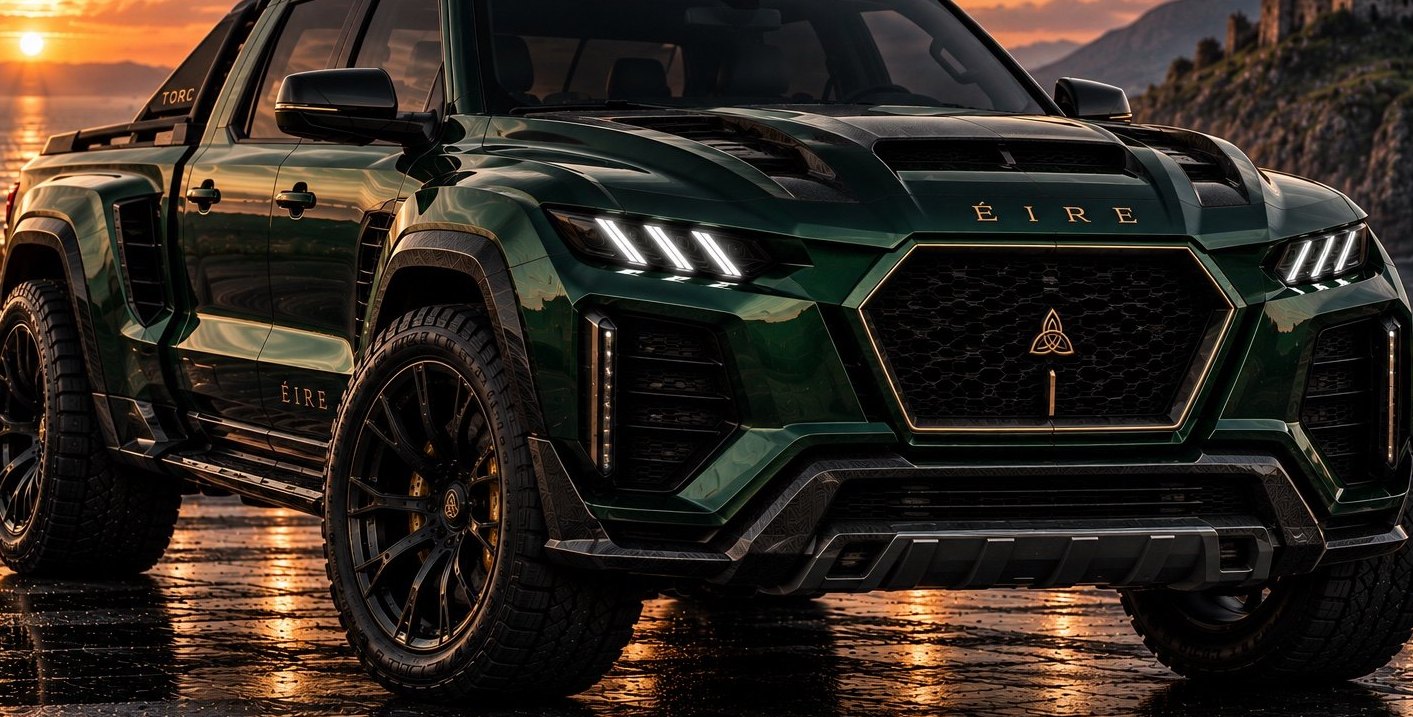
The brief we set ourselves is easy to say and hard to do: the super-truck you can actually use as a truck. TORC is a full-size, crew-cab luxury performance pickup. It has a bed. It seats a crew. It tows. It does the things a truck is for, and it does them at a level of finish that belongs in the same family as the Eden GT.
The scenario we keep coming back to is the one on the poster. Tow the Banshee to the track. Drop the trailer. Be the fastest thing in the lot. Most performance trucks manage one half of that — they are either fast or they are useful, and the fast ones tend to have beds you would not put a bicycle in. TORC is built to be both, without apology in either direction.
Torque, as promised
TORC is a plug-in hybrid, because that is the drivetrain that suits it. Every Éire gets the drivetrain that suits it, and for a truck the case for a serious electric side is stronger than for almost any other kind of vehicle. Electric power gives a truck what a truck most wants: torque from the first inch of pedal, before anything has spooled up, exactly when a loaded trailer is asking the most of it. It gives quiet for the early morning and the neighbourhood. And it gives the ability to move a large vehicle around town without waking the engine at all.
The engine gives the rest: the range, the sustained pull, the freedom to tow across a state with quick fuel stops rather than long ones. The two sides do what each does best, which is the same principle we hold to in the Eden GT. The difference is only in what the vehicle is for.
Irish DNA. American size. Global standard.
That is the line on the poster, and it is the design brief in six words. The proportions of TORC are unapologetically full-size. A truck that has been shrunk to look tidy in renders is not a truck, and we were not interested in drawing one. American size means American size.
What makes it an Éire is the face, and the discipline of everything around it. The emerald honeycomb grille carries the trinity knot in copper, scaled up to suit a nose this tall. The three-blade lighting signature cuts across the corners in the same proportion it does on the Eden GT. The copper is used sparingly. The paint is emerald. From the front, at a distance, you would know whose it was before you could read the badge, which is the whole test we set for every car in the family.
The other line on the art — Power has a homeland — is the one we like best. It says where the idea came from without pretending the vehicle is anything other than what it is.
What a concept looks like from the inside
A concept is not a rendering and a press release. It is a list of questions, each with a way of being answered. Does the honeycomb grille scale to a nose this tall without the knot becoming a badge on a wall? Does the three-blade signature still read as three blades when the lamps are this far apart? Does the bed stay an honest bed once the rear of the truck has been given the family's shape, or does styling quietly eat the thing the vehicle is for? Does a plug-in hybrid that we would put in a grand tourer make sense when the vehicle spends its hardest miles pulling a trailer uphill?
The renders answer the first questions, which is what renders are for. The rest are answered with engineering, on paper and then in metal, and that is a stage TORC has not reached. We are telling you where the concept is rather than where we would like it to be, because that is the only honest way to show a vehicle at this point in its life.
Where it sits
We use two labels for the cars in the Éire family, and we use them carefully. In development is real engineering underway now. Concept is a design study for a car that is on the ladder and will be earned by the one before it. TORC is a concept, and it is on the ladder.
It sits fourth, after the Eden GT and Balor, and that is the sensible progression: the grand tourer first, then the car that widens the family to five seats, then the truck that carries the same face and the same drivetrain philosophy onto a bed and a tow hitch. The Banshee and the Dagda follow it. Nothing about the Eden GT depends on TORC, and everything TORC becomes will be earned by the cars before it.
What we are not saying
We are not quoting figures for TORC and we will not. Towing capacity, output, range — all of it belongs to a stage the concept has not reached, and a concept that quotes numbers is pretending to be something it is not. What we can say is what we have said: a full-size crew cab, a plug-in hybrid, a real bed, a real tow, and the family's face on the front of it.
The Eden GT comes first. It always has. TORC is the truck that family deserves, and we will show you more as the design matures.