From dials to software
The instrument panel was once a fixed object — milled, riveted, and finished long before the car was driven. Its information never changed because it could not. A great electric grand tourer inverts that idea entirely: the cockpit is now software, a surface that composes itself around the moment. The same panel that shows a serene map at dawn becomes a focused performance readout on an empty mountain road, then dims to a single line of charging information overnight.
This shift is not merely cosmetic. An electric drivetrain has fewer mechanical theatrics to report — no tachometer sweeping toward a redline, no gearbox to interpret. What it offers instead is data of a subtler kind: energy flowing out and recovering back in, range measured against the road ahead, climate balanced silently against the weather. The cockpit's task is to make that invisible choreography legible without ever shouting.
Done poorly, the result is a tablet bolted to a fascia — bright, busy, and forever demanding attention. Done well, it disappears into the experience of driving, surfacing exactly what is needed and nothing more. That distinction is the whole art of the modern cockpit.
What makes a great cockpit
A cockpit worthy of a grand tourer should be, above all, calm. The driver's eyes belong on the road; every glance inward is a small debt to be repaid quickly. The finest interfaces are therefore glanceable — speed, range, and the next instruction read in a fraction of a second, laid out with the typographic restraint of a good wristwatch rather than the clutter of a smartphone.
It should be beautiful, because a grand tourer is an object of desire and the cockpit is where one actually lives. And it should be useful — navigation, climate, media, and charging reachable without a treasure hunt through nested menus. What it must never be is gimmicky: animation for its own sake, novelty that delights once and irritates forever.
The hardest discipline in interface design is subtraction. Anyone can add a screen, a widget, a flourish. The marque worth admiring is the one with the confidence to leave the panel quiet — to trust that restraint reads, in the end, as luxury.
Two displays, one experience
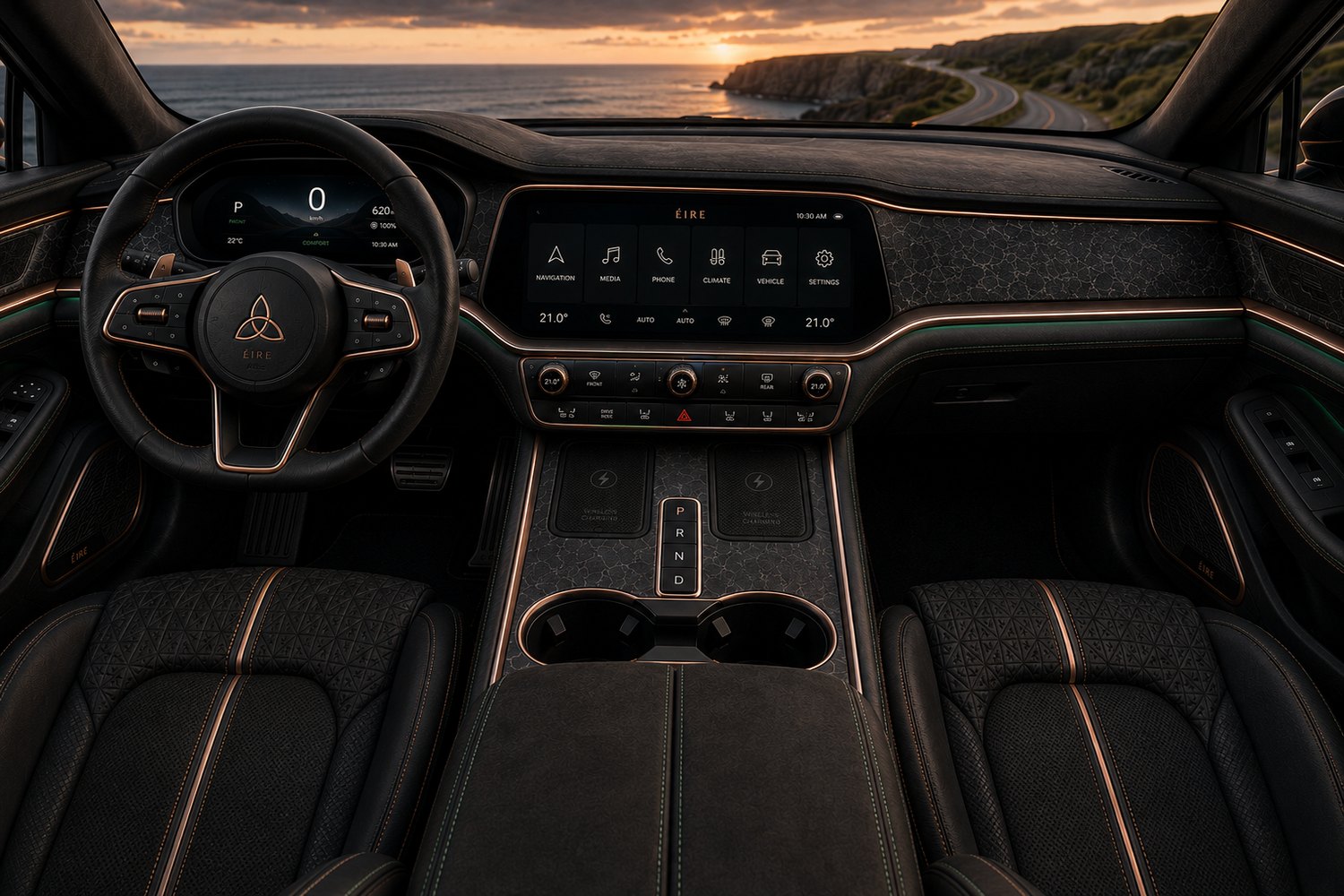
The Éire Eden GT is built around two surfaces working in concert: a large curved driver display set behind the wheel, and a centre touchscreen angled gently toward the hand. The first is the realm of driving — speed, range, turn-by-turn guidance, the live state of the car. The second is the realm of interaction — climate, media, charging, the choosing and the settling-in. Keeping those two intentions distinct is what stops a cockpit from feeling like one undifferentiated wall of glass.
Because the Eden GT's cockpit is software-first, you do not have to take any of this on faith. Both screens run live, in your browser, exactly as they are designed to behave in the car. Try the driver cluster to watch the instrument panel shift between calm cruising and a focused performance view; open the centre display to move through navigation, climate, media, and the charging screens at your own pace.
On the cluster, the trip computer keeps a quiet ledger of the journey — distance covered, energy used, efficiency earned — while turn-by-turn navigation rises into view only when a turn is near, then recedes. Selecting a drive mode redraws the panel to match the car's temperament: serene and economical, or sharpened for a spirited road and a hint of track intent.
On the centre display, a charging screen shows the state of the battery and the time to a chosen target in plain language rather than a wall of figures. Media and climate sit a single touch away, and a voice assistant handles the rest — a destination, a temperature, a song — so that hands and eyes can stay where they belong.
Atmosphere, craft, and the Irish hand
A grand tourer is measured not in a single corner but across a long day's drive, and atmosphere matters as much as information. The Eden GT's cockpit is designed around ambient moments — gentle shifts in light and tone that mark a welcome, a sunset, the close of a journey — never theatrical, always in service of the mood rather than the spectacle.
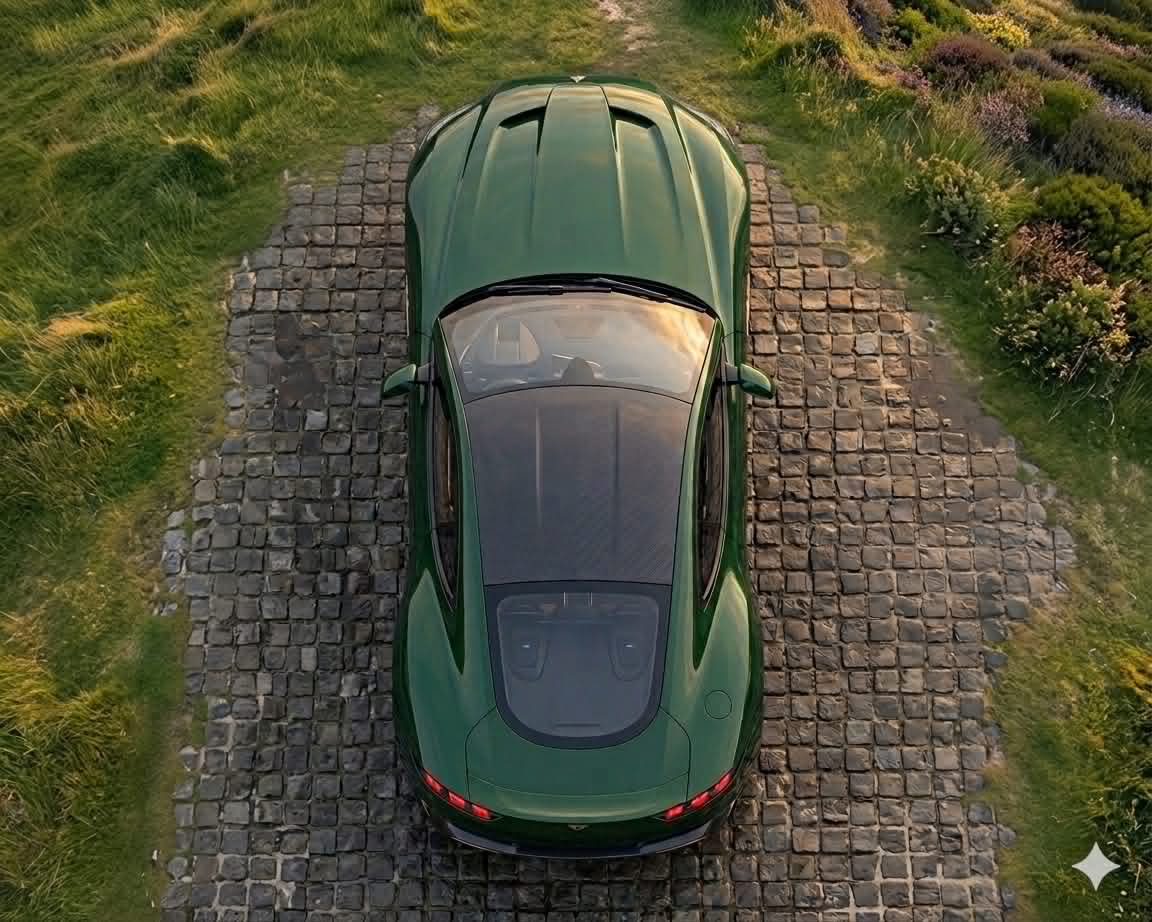
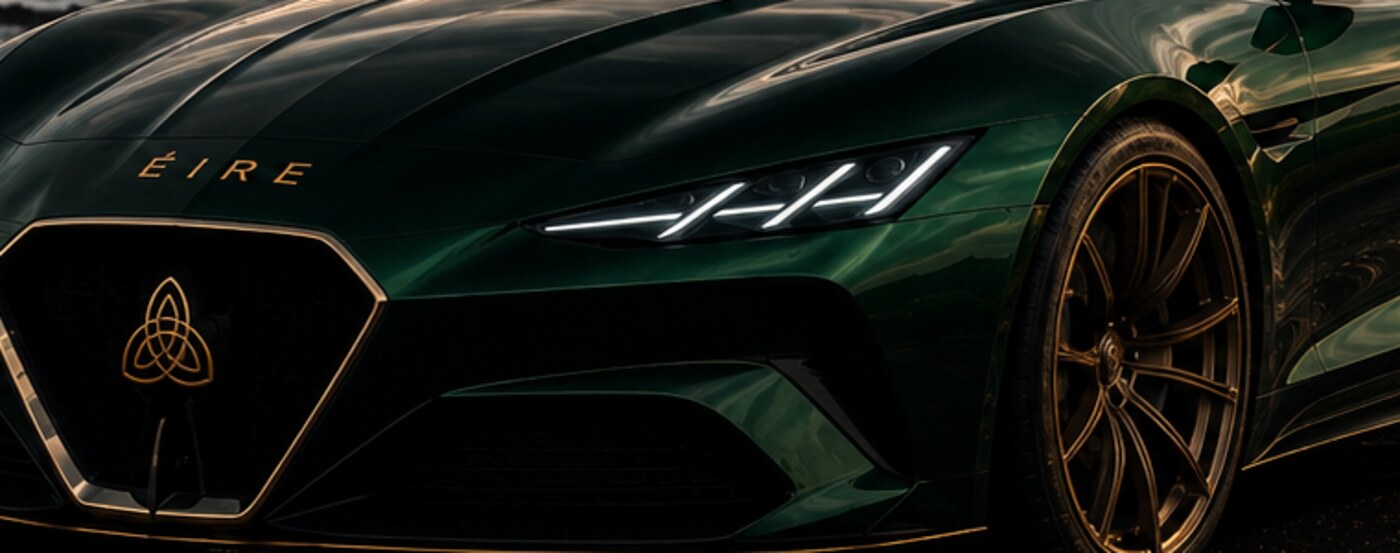
This is where software meets the marque's deeper character. The Eden GT is hand-finished with Irish-inspired craft, and the digital cockpit is meant to extend that sensibility into light: the same restraint, the same warmth, the same refusal of the garish. A near-silent, all-electric 2+2 deserves an interface that honours the quiet — calm typography, unhurried motion, colour drawn from landscape rather than neon.
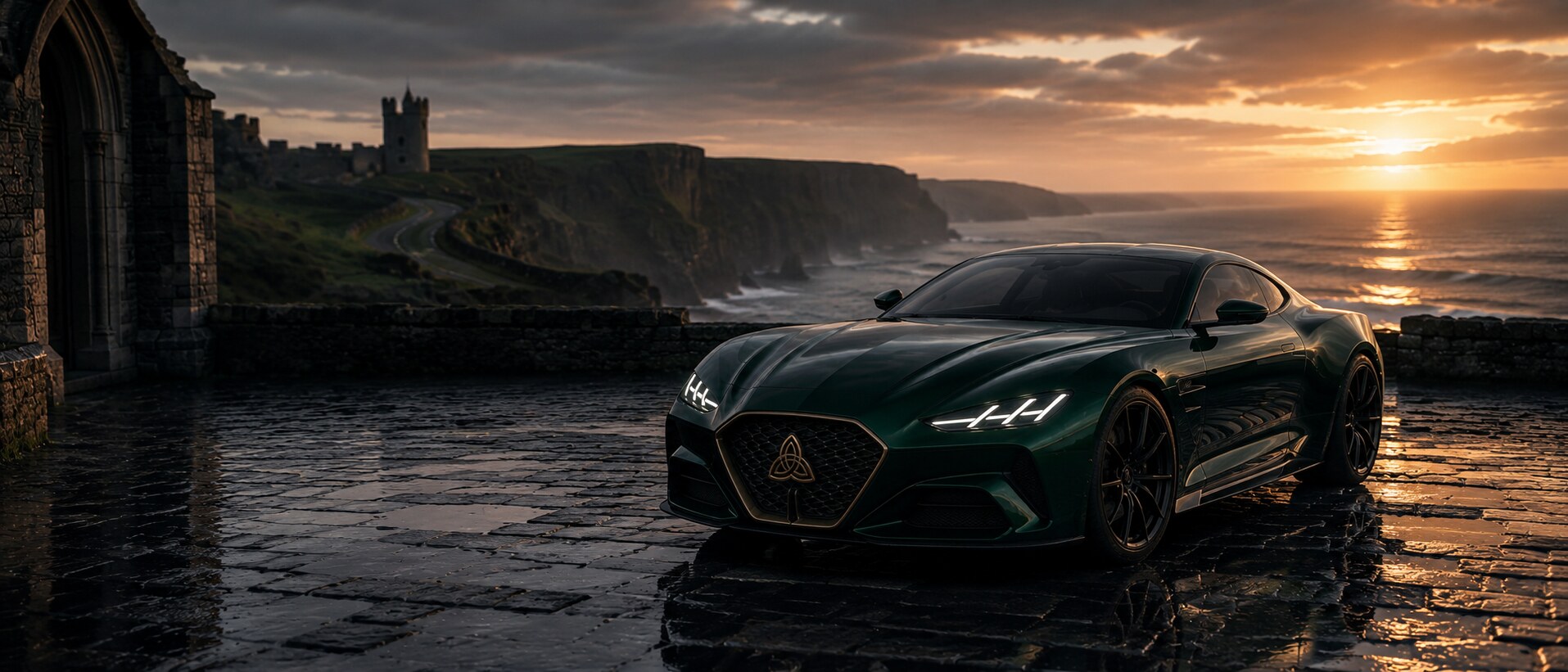
It is worth saying plainly that the Eden GT is currently in development, strictly limited to fifty cars, and that what you can preview today is the designed experience rather than a finished production unit. But the cockpit is not a sketch — it is software you can use now, the genuine logic and feel of the interface, evolving toward the car it will live in.
Born of Ireland and built for the world, the Eden GT treats its digital cockpit as craft of a new kind — pixels finished with the same care as leather and metal, in pursuit of a drive that feels effortless, beautiful, and entirely its own.