A Light That Refuses to Sit Still
Anyone who has stood on the western edge of Ireland knows the particular drama of its light. It arrives off three thousand miles of open ocean, unfiltered and changeable, and it never quite settles. A hillside that was slate-grey at breakfast turns a luminous, almost impossible green by noon, then sinks to bronze as the cloud thins at dusk. The weather is not an interruption here; it is the medium through which everything is seen. To design for such a country is to design for movement — for surfaces that are read differently from one hour to the next.
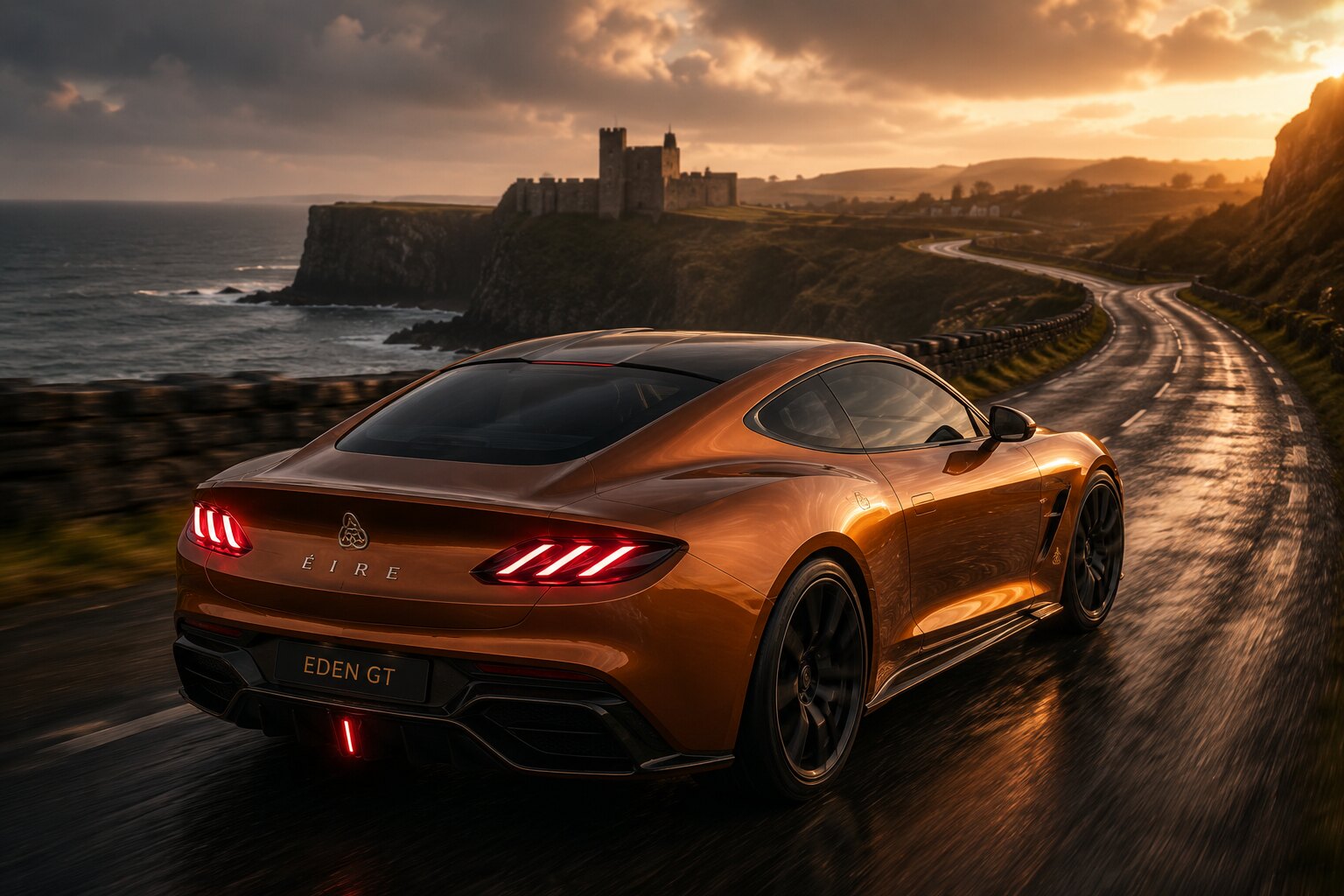
This is the first principle behind the Éire Eden GT. Where some marques chase a single flattering studio light, we wanted bodywork that lives in real Irish weather: panels long and unhurried enough to carry a moving highlight, paint with depth rather than flash. Midnight black is not chosen to disappear but to hold reflection, to gather whatever sky is overhead and give it back slowly. It is a luxury of patience rather than of spectacle.
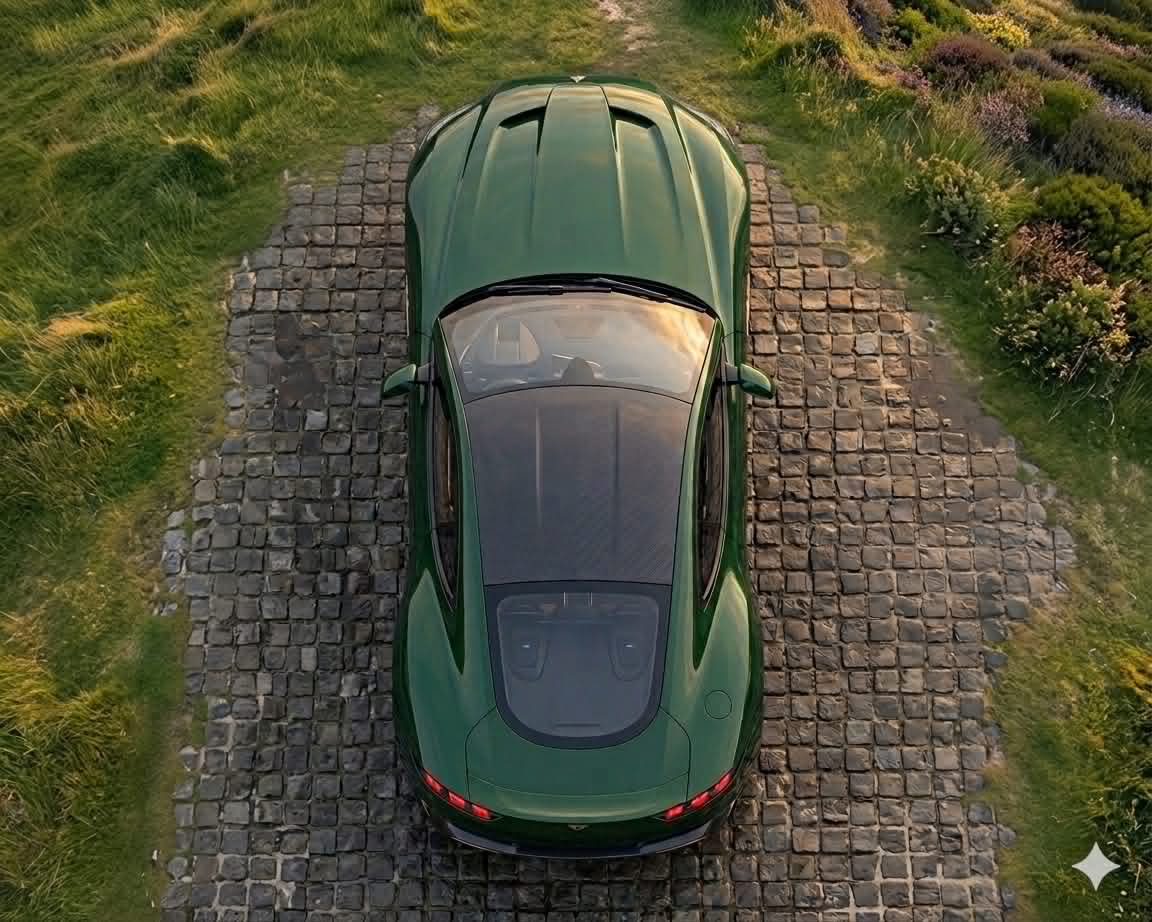
There is a palette in the land itself, and we have kept faith with it. The deep emerald of wet grass after rain. The cool ivory of limestone pavement worn smooth by centuries. The warm copper of cut bog and turned bronze. These are not decorator's swatches; they are the colours a person grows up inside, and they carry a feeling of home that no trend forecast can manufacture.
The Long Memory of the Hand
Ireland's claim to luxury is older than the word itself. Long before the marketing language of heritage, there were makers here doing patient, exacting work: the spinners and weavers who turned coarse local wool into cloth fine enough to last generations; the silversmiths whose hallmarks are among the oldest continuously recorded in Europe; the glass cutters who learned to throw fire and prism into clear crystal; the joiners who read the grain of native timber before they ever raised a tool to it.
Above them all sits the illuminated manuscript — those astonishing pages where monks spun a single initial letter into a labyrinth of interlace, beasts and knotwork so dense it seems to breathe. That tradition of Celtic ornament is not decoration applied at the end. It is structure made beautiful, line that never breaks and never quite resolves, an idea of endlessness rendered by hand. It tells you something about the culture that made it: a people willing to spend a lifetime on a detail almost no one would see closely.
We take that inheritance seriously. The Eden GT is hand-finished, and the marks of the hand are meant to be felt rather than hidden — the weight of a woven textile, the warmth of wood chosen for its character, the cool honesty of metal. Luxury, in this reading, is not the absence of effort. It is effort made invisible only at the point of use, and quietly present everywhere underneath.
The Triquetra, and the Case for Restraint
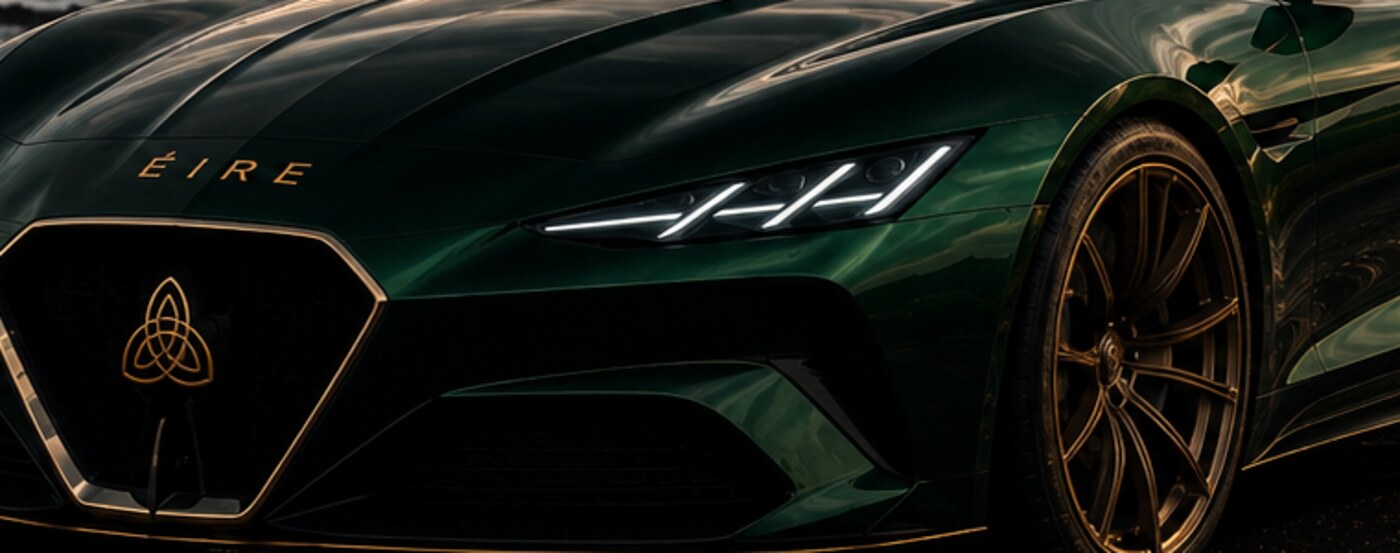
Every marque needs a mark, but a mark can be loud or it can be considered. Ours is the triquetra — three arcs woven into a single unbroken line, an emblem the Irish imagination has carried for well over a thousand years. It has meant many things across the centuries, but at its heart it is about continuity: three made one, a line with no beginning and no end. Rendered in bronze and set with restraint, it stands for the same idea that runs through the whole car — that the things worth making are the things that hold together.
We rendered it in bronze deliberately. Bronze warms with handling and age; it is a metal that improves by being lived with, rather than one that demands to be kept pristine. That single choice says more about our idea of luxury than a page of specification could. We are not interested in objects that punish their owners for using them.
Restraint is the Irish note that the rest of the industry tends to miss. German luxury can read as a demonstration of engineering; Italian luxury as a performance of beauty; British luxury as an exercise in formality and rank. None of these is wrong, but none of them is us. The Irish instinct is to underplay — to let warmth do the work that ostentation does elsewhere, to trust that the person who knows will notice, and that the person who doesn't was never the point.
Warmth, Story and the Long Drive
There is a reason the grand tourer suits the Irish temperament so well. The whole idea of the GT is the journey for its own sake — distance crossed in comfort, the road as something to be savoured rather than merely survived. That is a deeply familiar pleasure in a country whose roads wind along cliff edges and through mountain passes, where the point of going was always as much the going as the arrival.
Irish culture is, before anything else, a storytelling culture. A car built in that spirit is not a sealed appliance but a companion for the tale you are in the middle of living — the late drive home along the coast, the road trip that becomes a memory. The Eden GT is a 2+2: room for the people the story is about, not a solitary instrument of speed. Its software-first digital cockpit is shaped by the same instinct — technology that quiets itself and serves the moment, rather than demanding to be admired.
And then there is restraint of a different kind: scarcity. The Eden GT is in development, and it will be strictly limited to fifty cars. That number is not a marketing flourish but an honest statement about how this kind of work is done — slowly, by hand, with care that does not scale infinitely. Fifty people will own something genuinely particular: a grand tourer that is electric, hand-finished, and unmistakably of one place. Born of Ireland. Built for the World.