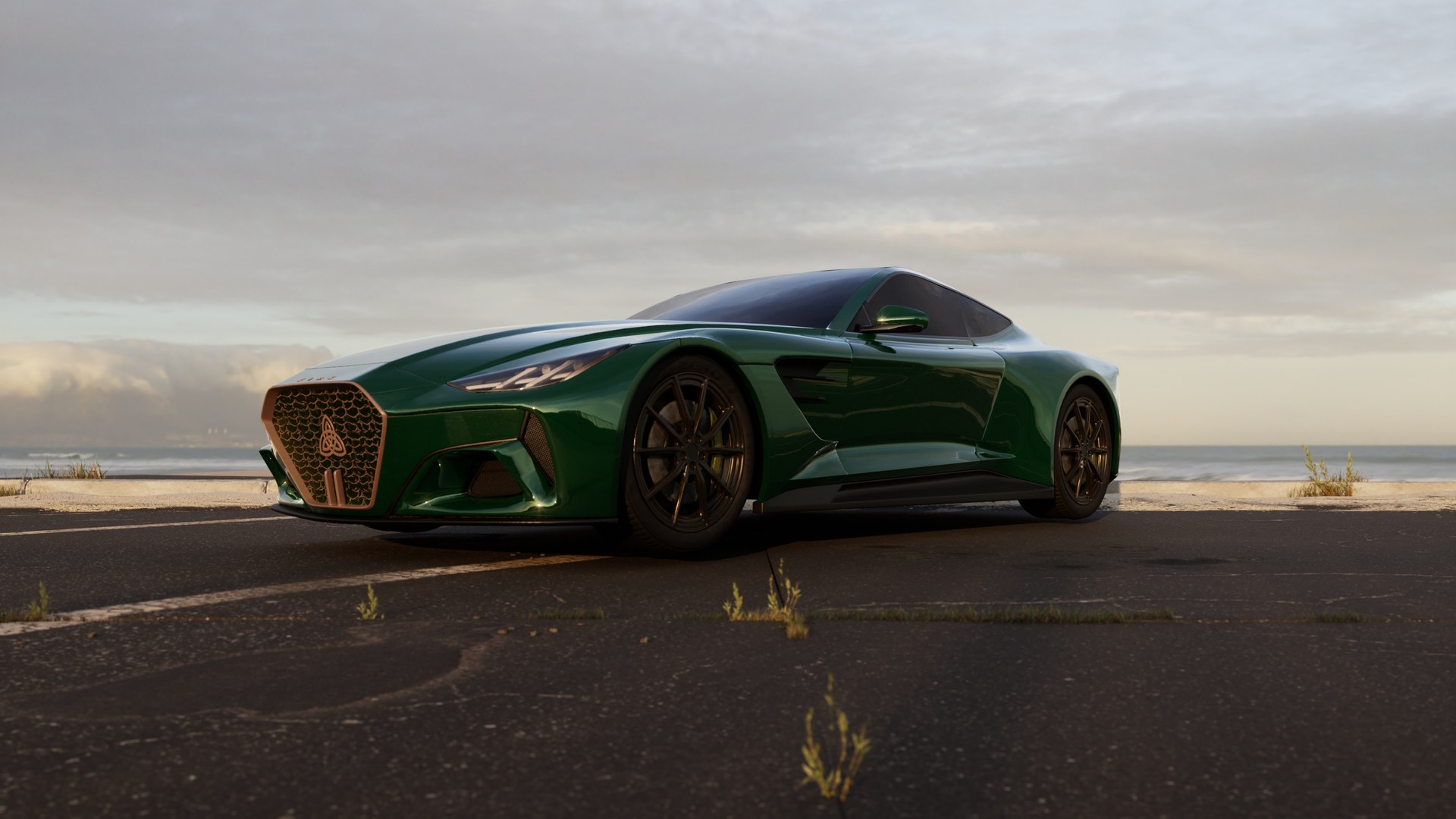
Why forest green
Most of the Eden GT photography you have seen from us is silver. Silver is honest about surfaces: it shows every crease and every soft transition without the paint adding anything of its own. But silver is also quiet to the point of disappearing, and a grand tourer should not disappear. So for this set we went the other way and painted the engineering model the colour we always meant for it.
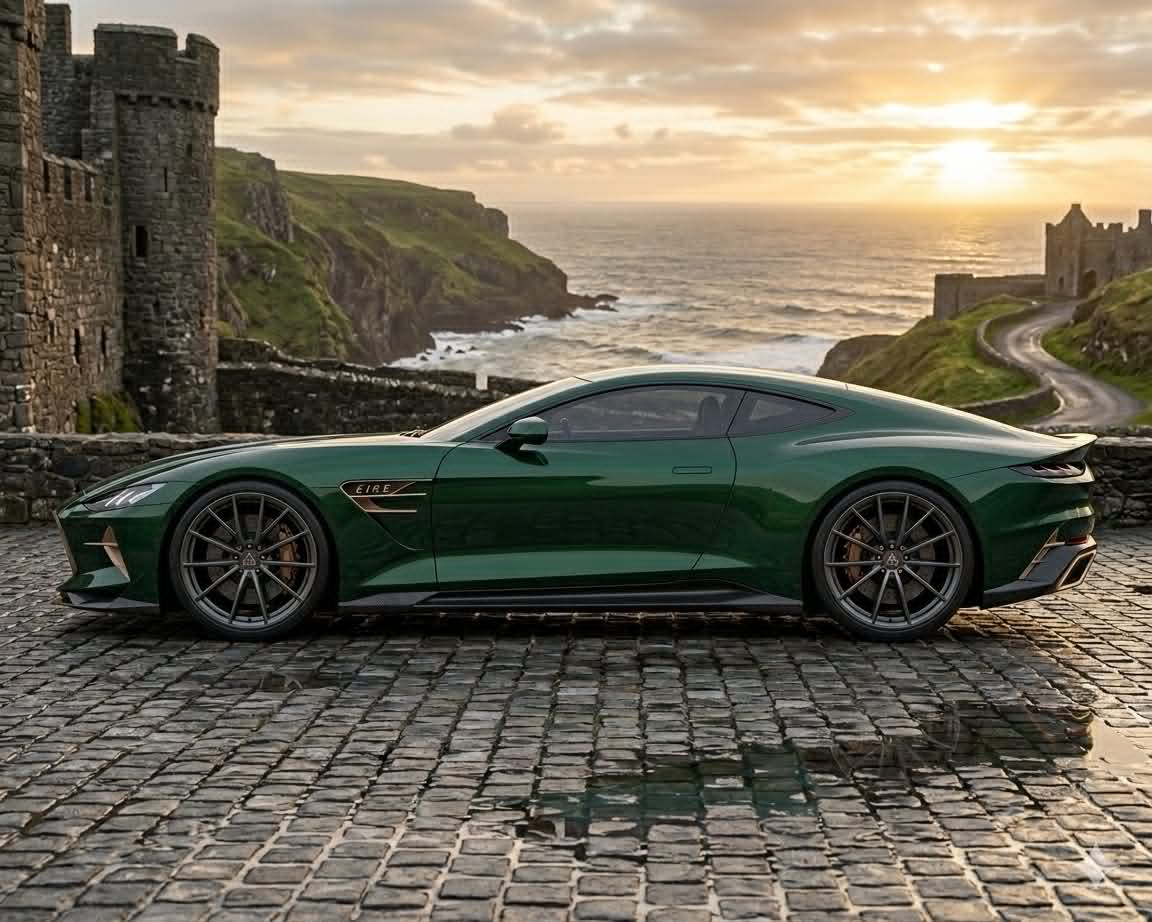
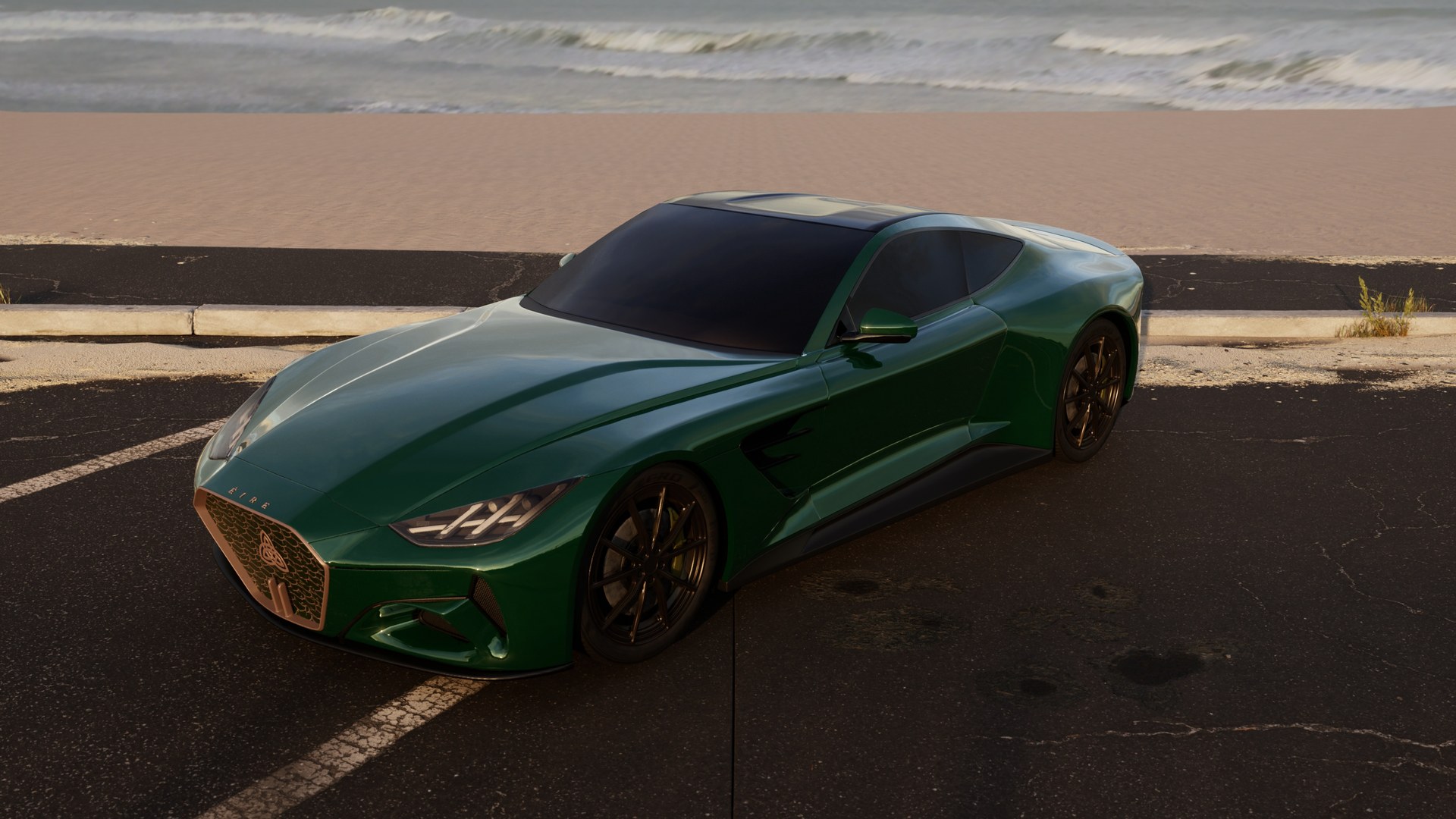
Forest green is the darker, deeper relative of Irish racing green — the colour first worn in 1903 on Irish roads, as we covered in our history of Irish racing green. In full sun it is unmistakably green. In the low light of a coast at dusk, which is where most of these photographs were made, it goes nearly black on the shadow side and holds a liquid green on the lit side. That split is the point. A car this long needs a paint that shows you where the body turns, and dark green does it better than any bright colour we tried.
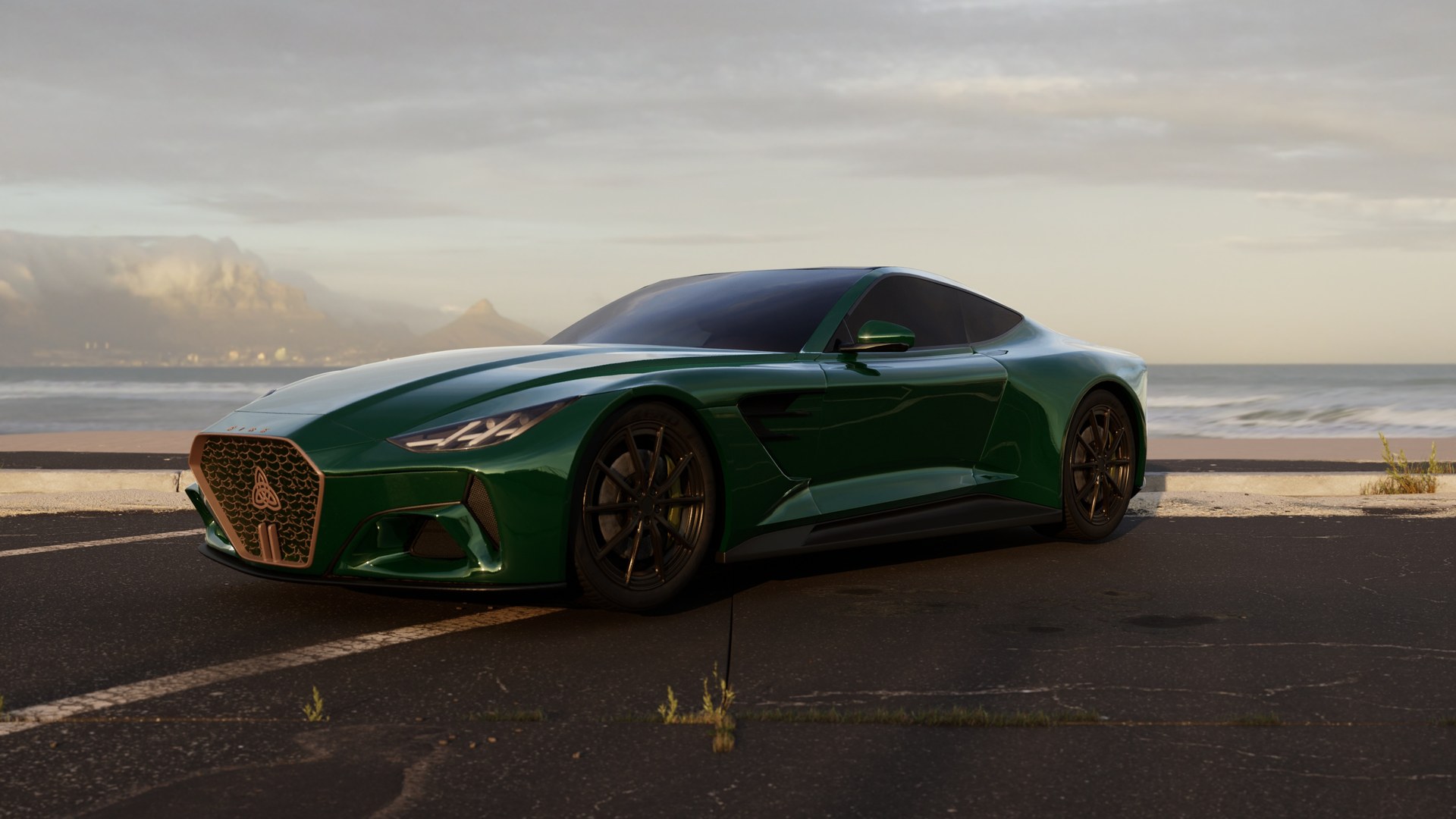
It also sits right with the copper. Éire’s detailing is brushed copper rather than chrome, and copper against green is a warm, old pairing — the kind you find on a well-kept door in Cork rather than on a trade-show stand. This is the one the car was drawn in.
The nose and the grille
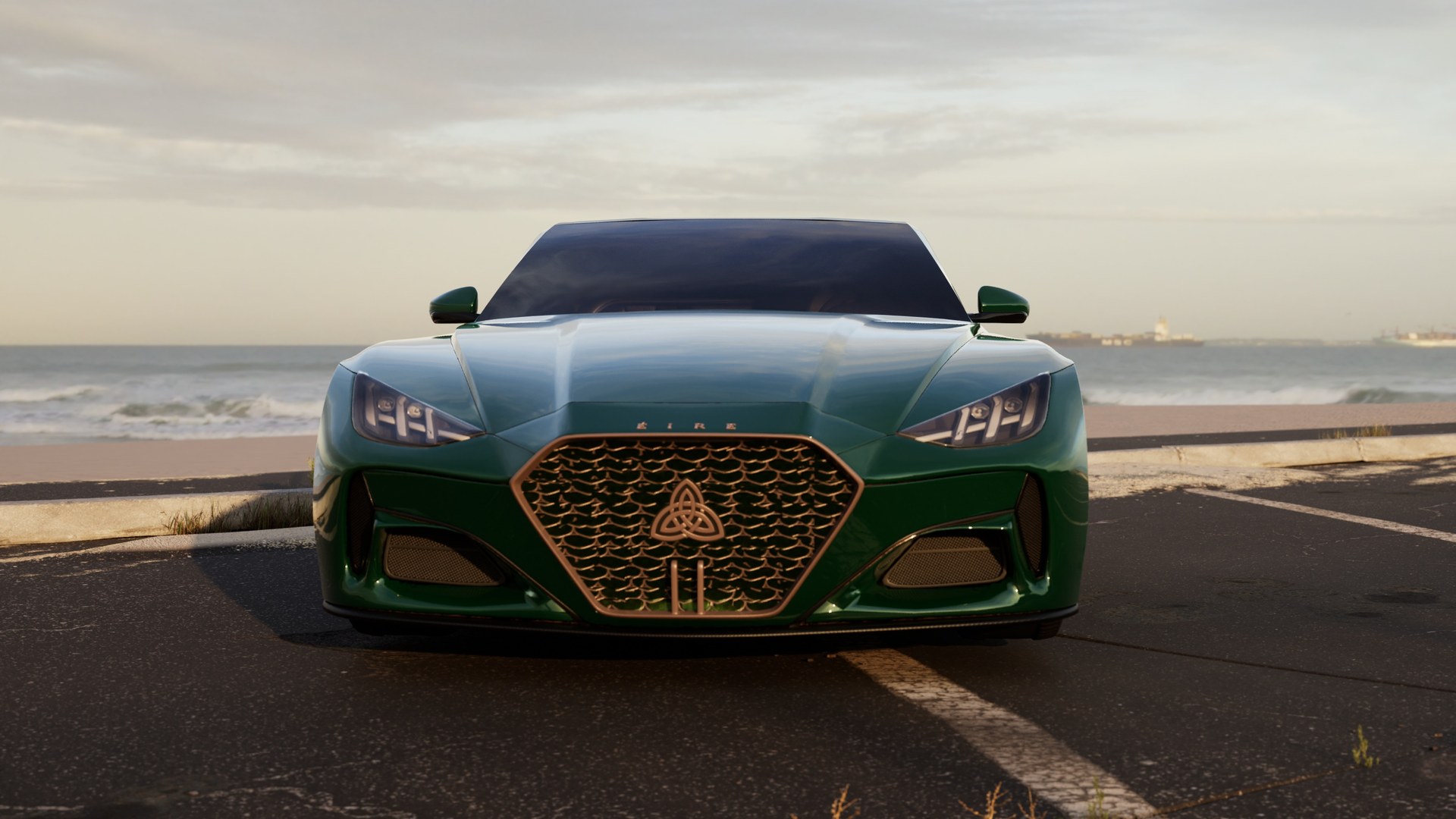
Walk to the front and the first thing you meet is the grille: a single tall shield, framed in copper, filled with a mesh of overlapping scales and carrying the triquetra at its centre. It is a large opening for a car this low, and that is deliberate. A V8 plug-in hybrid has a lot to keep cool — the engine, its turbochargers, and the battery and electrical system behind them — and we would rather feed that with one honest intake than hide it behind a false panel.
The scale pattern comes from the same place as the rest of the car’s identity. Irish metalwork — the Tara brooch, the Ardagh chalice, the pages of Kells — repeats small forms until they become a surface, and the grille does the same thing in metal. It is not a decoration bolted on afterwards. It is the structure of the opening.
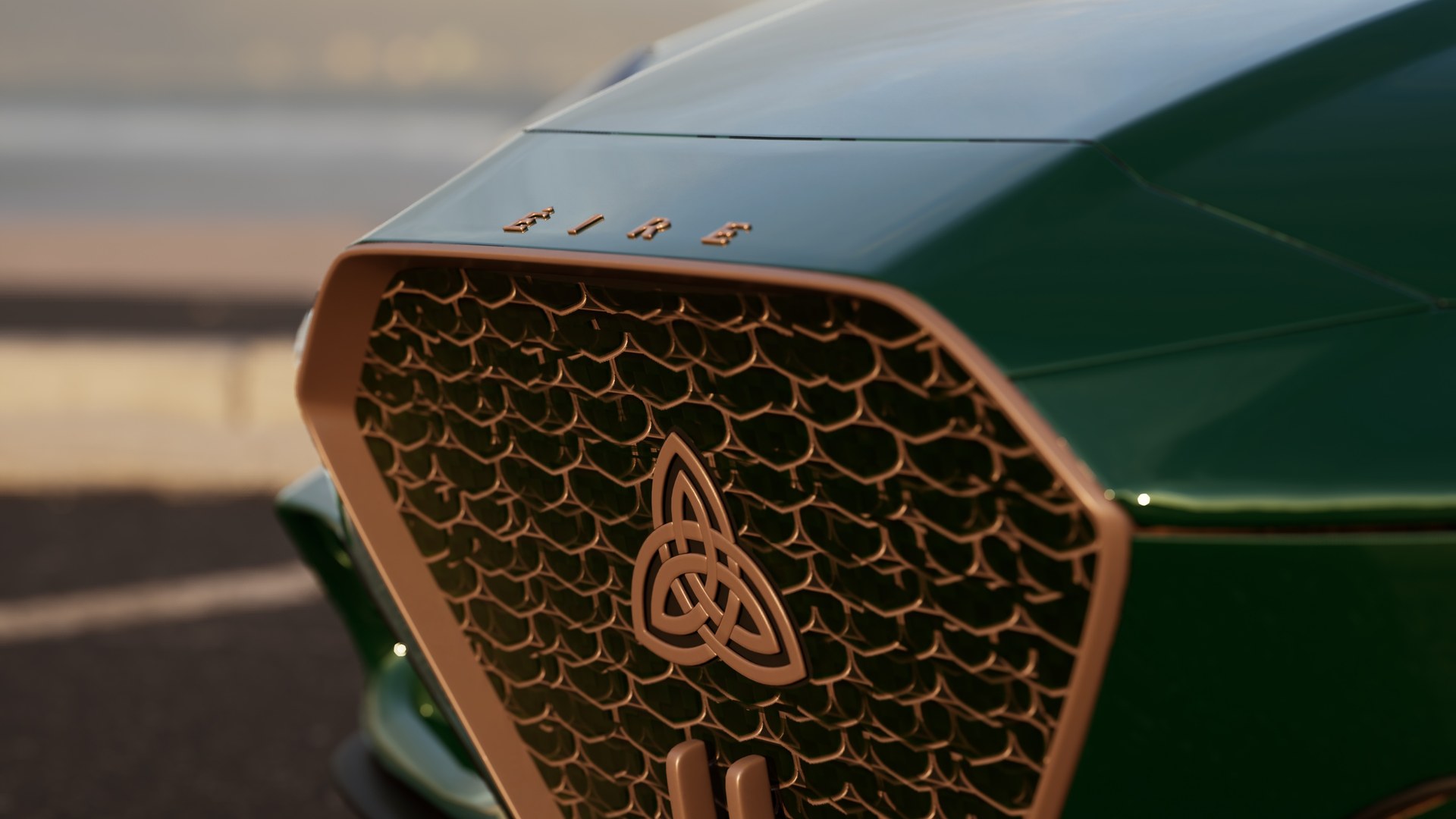
Above the grille, the bonnet edge carries the name in small copper letters. Below it, two low intakes at the corners do the practical work of cooling the brakes and feeding the underfloor. The headlamps are kept thin and pushed outboard. We wanted the front to be read as one shape — a shield and a bonnet — rather than a collection of features competing for attention.
The profile and the proportions
The side view is where a grand tourer is either right or it is not, and it is the view we spent the longest on. The bonnet is long. The cabin sits well back over the rear wheels. The roof falls in a single unbroken line from the top of the windscreen to the tail. Those three decisions are the whole car; everything else is detail.
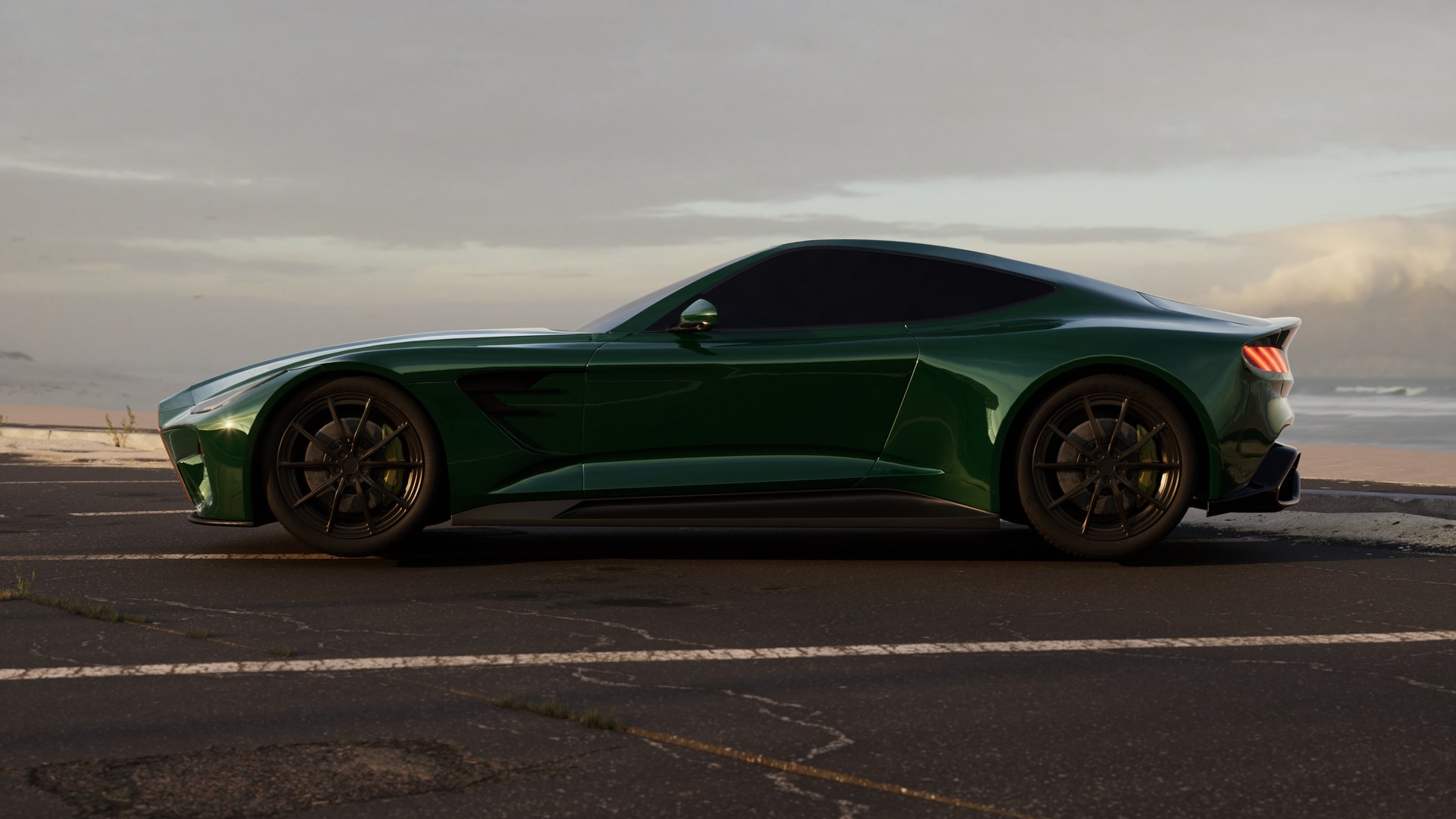
If you have read our guide to reading proportions, you will recognise what you are looking at: a long dash-to-axle, short overhangs, and a shallow glasshouse over high body sides. That is the classic front-engined formula, and we did not try to reinvent it. A V8 in the nose and people in the middle produce a certain silhouette, and the honest thing is to draw that silhouette as well as you can.
Two things in the profile are worth pointing out. The first is the vent behind the front wheel, a set of horizontal blades let into the flank that relieves pressure from the wheel arch; it is functional first, and shaped second. The second is the sill. The lower body is tucked in under a dark sill that runs the full length of the car, so from most angles the green body appears to float a little above the road. That is an old trick, and it works.
The rear and the tail lamps
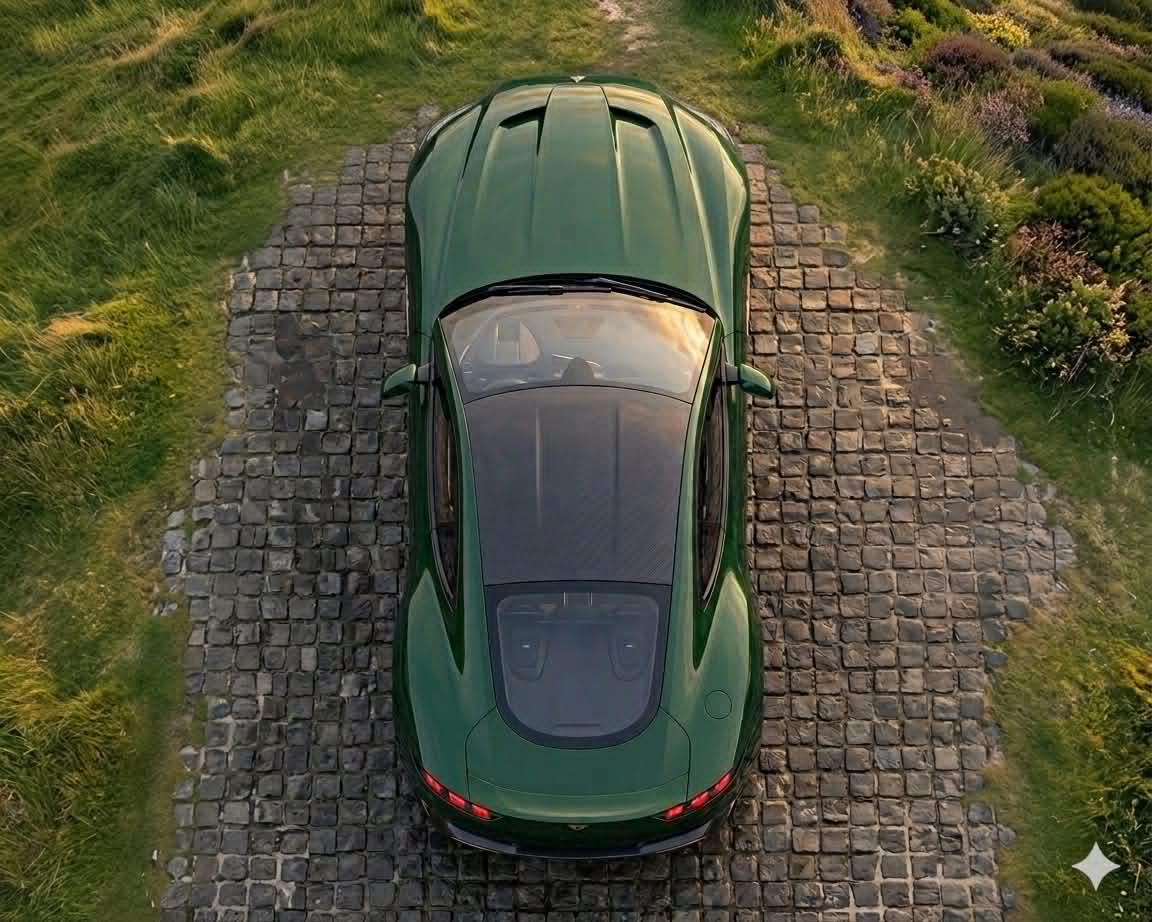
The tail is where the Eden GT is most itself. The roofline ends in a short, raised lip — not a wing, just the body lifting at the last moment — and below it, the rear deck is a clean plane carrying the name and the triquetra. The lamps are three diagonal slashes on each side, lit here while the car is parked.
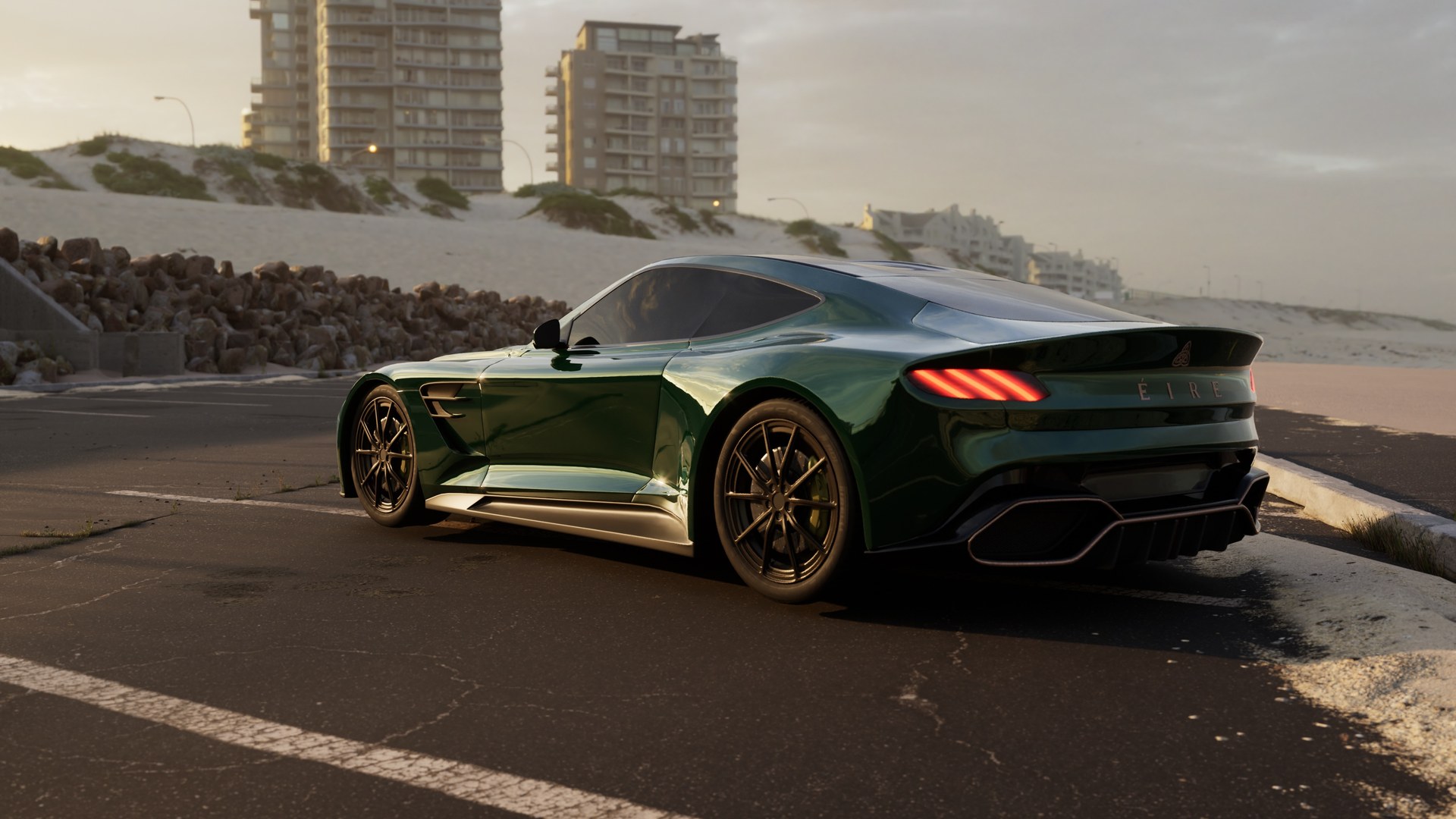
The three slashes were not an accident of styling. We wanted a rear signature that could be recognised at a distance and in the dark, that was not another full-width light bar, and that carried a little of the triquetra’s three-part logic without spelling it out. Three cuts, angled with the car’s motion, did that.
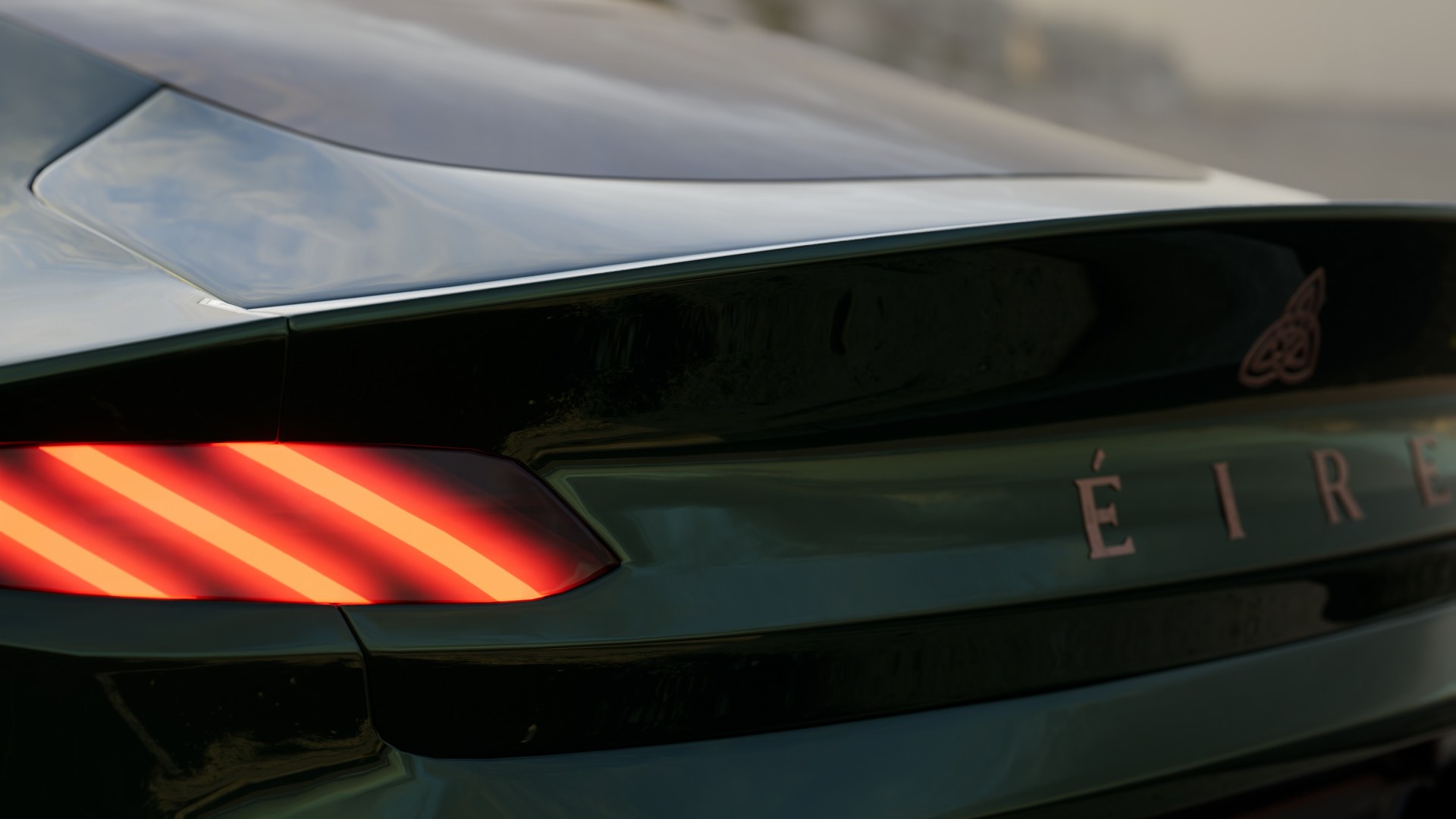
Below the lamps, the lower rear is dark and functional: a diffuser between the exhaust outlets with a copper edge to tie it back to the nose. We kept the rear panel simple on purpose. A long car with a lot going on at the front needs a calm back end, or it reads as two different cars.
The wheel and the stance
Get low at the front corner and the Eden GT shows you the part most photography skips. The wheels are a slim, many-spoked design in a dark finish, chosen to show as much of the brake as possible. Behind them sit drilled discs and a caliper in a sharper green than the body. That caliper is the only place on the car where the green is allowed to shout.
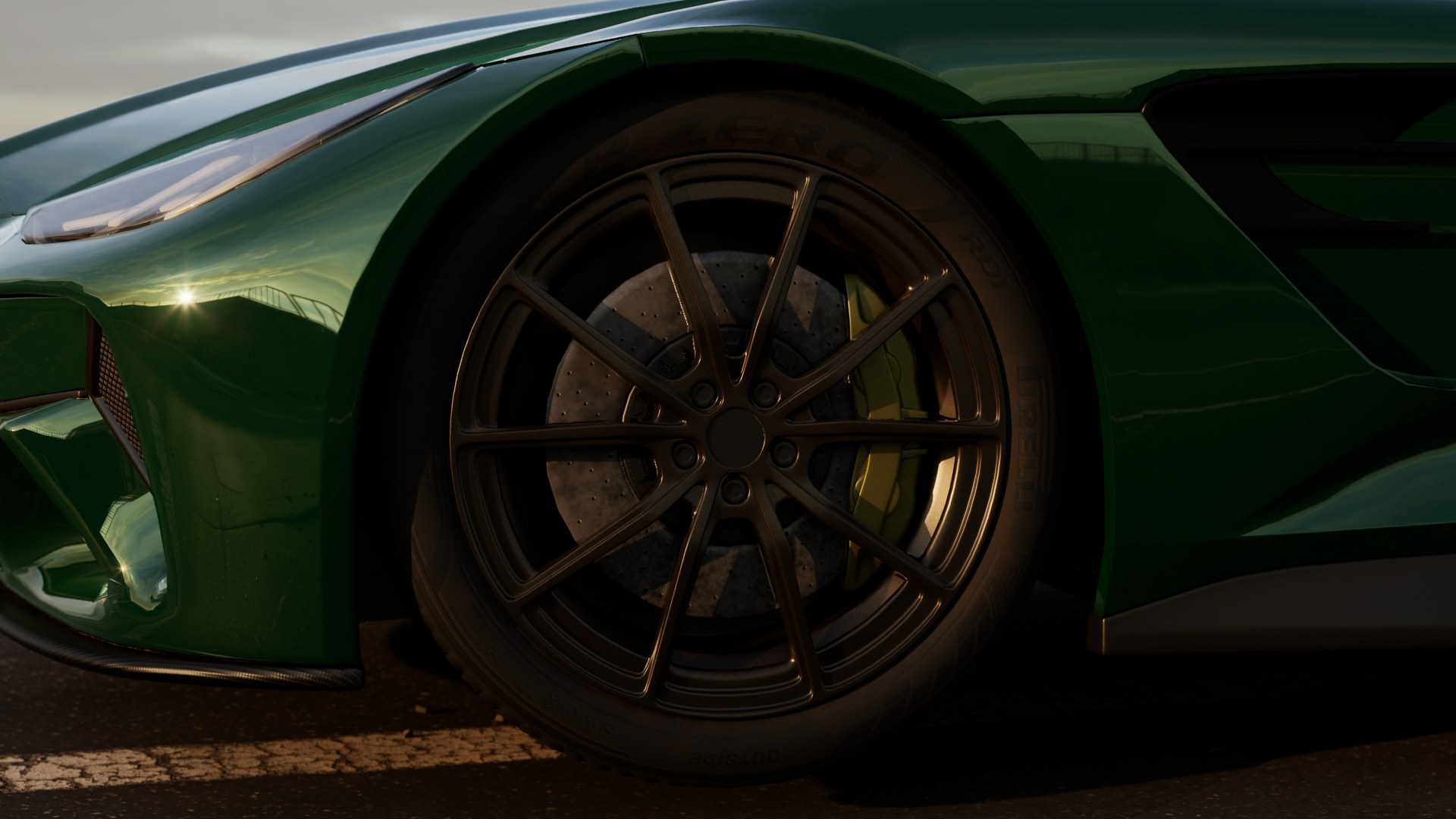
Stance is the thing a photograph can show that a drawing cannot. The Eden GT sits with its wheels pushed hard to the corners of the body and the tyre filling the arch, which is why the low front three-quarter at the top of this article works the way it does: the car looks planted before it has moved. That is not a trick of lens or angle. The model is built to the car’s intended proportions, and the stance in these photographs is the stance we are engineering toward.
We are aware that stance in photography is cheap and stance on a road is expensive. It is set by track width, by ride height, by how the suspension is tuned to carry the car’s weight — and all of that is engineering, not styling. We show these images because they are an honest picture of the target, not because the work is done.
What comes next
These are photographs of the Eden GT engineering model, the one we design and measure against. It is not a finished car, and we will not describe it as one. The surfaces you see here are the surfaces we are committed to; the details — lamps, grille, wheels — are current and may still be refined as the engineering underneath them settles.
The order of things at Éire is fixed. The Forge Mk I, our all-electric open development car, reaches the road first and teaches us what we need to know. The Eden GT follows, with production opening as a numbered Founder Series of fifty. We will keep photographing the model as it changes, and we will keep saying plainly what has changed and why.
For now, this is the car: forest green, copper, a long bonnet and three slashes of light at the tail, standing on a coast road at the end of a day. We think it looks like what it is.