Two Skeletons, One Philosophy
The exoskeleton track car is a wonderfully honest thing. There is no bodywork to hide behind, no insulation to soften the world — just a frame, two seats and the road rushing past your elbows. The Ariel Atom defined this breed: a road-legal, track-obsessed featherweight whose exposed tubular structure became one of the most recognisable silhouettes in performance motoring. It is, by any measure, a legend.
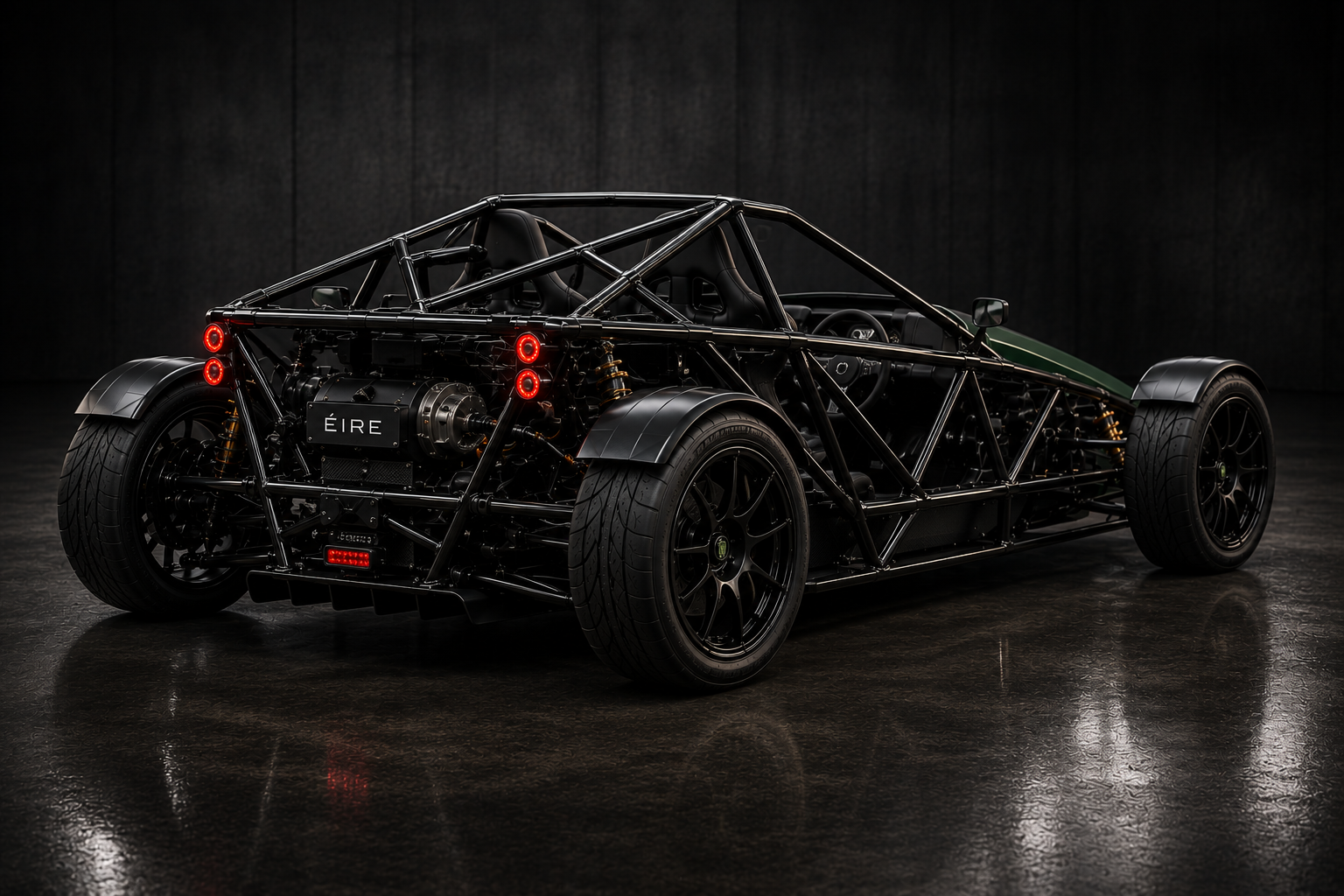
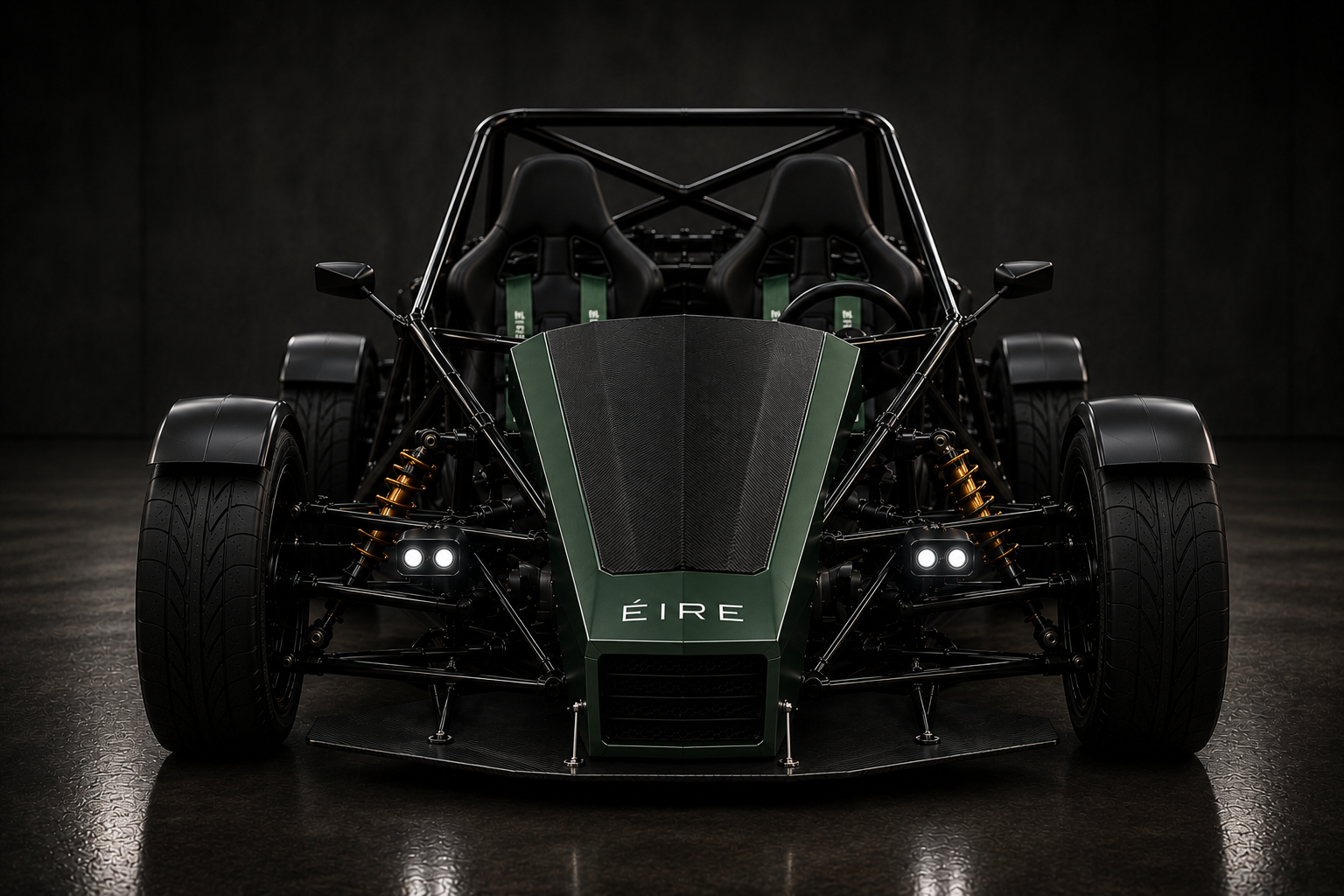
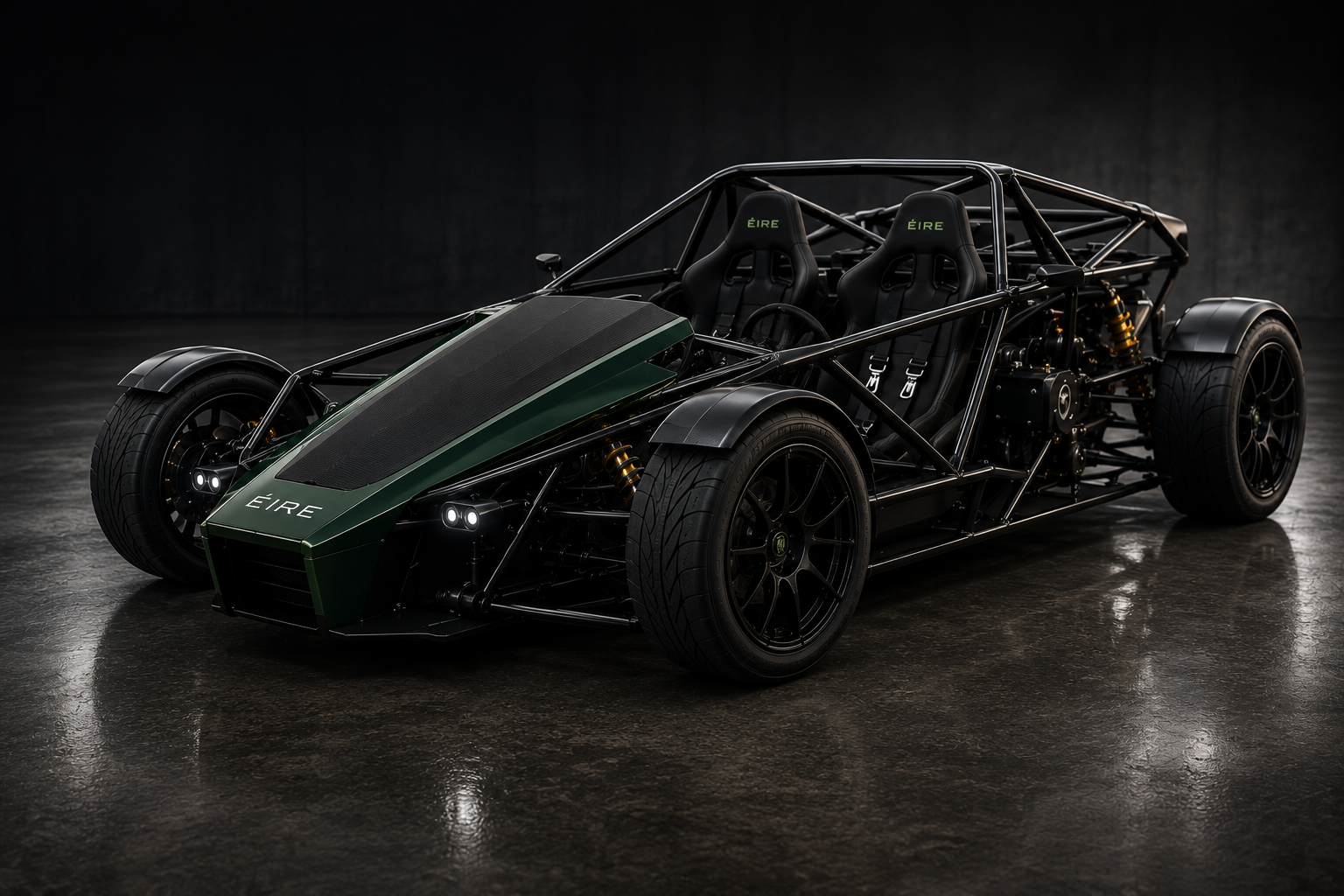
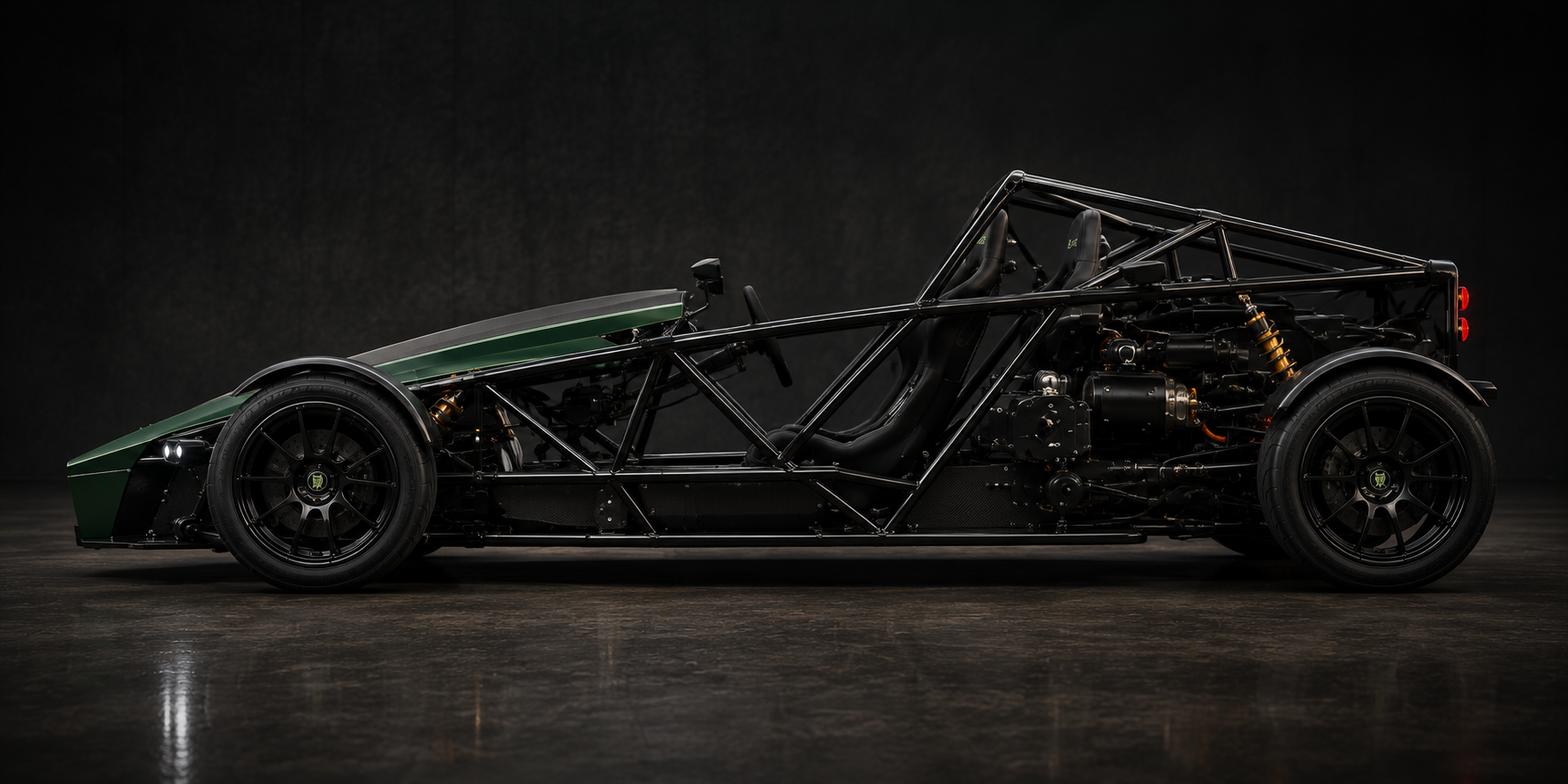
The Éire Forge Mk I shares that creed entirely. It is an open-cockpit, two-seat machine built around an exposed tubular steel spaceframe — a structure that is both the car’s chassis and its defining sculpture. Finished in deep Irish racing green, it carries the same uncompromising intent as the Atom while charting a different course to the same goal: maximum sensation, minimum mass. Nothing stands between driver and experience.
Where the two diverge is in the heart of the machine — and that single difference reshapes everything around it. The Atom looks back to a celebrated formula; the Forge reinterprets it for a new era. Both, however, begin from the same first principle: that lightness is the purest form of performance.
The Numbers — Closer Than You’d Think
The Atom’s reputation rests on a savage power-to-weight ratio. Widely reported to weigh somewhere around 1,200–1,350 lb in its lighter forms, and traditionally powered by a supercharged Honda four-cylinder producing roughly 300–350 hp depending on specification, it has long delivered acceleration figures that humble cars costing many times more. Those are durable, well-known truths — and they set a formidable benchmark.
The Forge answers with a weight target of roughly 1,800–2,050 lb and a design intent of around 295 hp, giving a power-to-weight figure in the region of 6.6 lb per hp. On paper the Atom’s lighter examples hold an edge in outright mass. But the Forge’s power arrives differently: instantly, fully, from the very first millimetre of throttle, with no supercharger to spool and no gearchange to interrupt the shove.
That distinction matters more than a spec sheet suggests. A petrol engine builds toward its peak; an electric drivetrain delivers its peak immediately. Paired with rear-wheel drive and a mechanical limited-slip differential, the Forge’s instant torque is metered out with traction and control rather than drama for drama’s sake — design targets, naturally, for a car still in development.
Theatre Versus Immediacy
This is where the two cars stop being rivals and start being philosophies. The Atom is theatre — the supercharger’s whine, the four-cylinder’s rising shriek, the mechanical conversation between throttle, gears and revs. Driving one is a full-body collaboration with an engine that demands to be worked. For many enthusiasts, that mechanical purity is the point, and no electric car can replicate it.
The Forge offers the opposite intoxication: near silence, then a single, seamless surge of acceleration that feels less like an engine and more like a force of nature. There is no waiting, no building, no shifting — only immediacy. You think it, and the car is already moving. It is a different kind of drama, one defined by precision and the eerie violence of instant torque.
Neither approach is superior; they are simply different answers to the same question of what a stripped-back driver’s car should feel like. The Atom rewards the driver who loves to extract, to rev, to row through the gears. The Forge rewards the driver who craves response so immediate it borders on telepathic. Choosing between them is less a matter of numbers than of temperament.
Heritage, Rarity and the Irish Newcomer
The Atom’s greatest asset beyond its performance is its lineage. It is an established legend with years of development, a devoted following and a proven record on road and track. Buying one means buying into a story already written — a known quantity, refined over generations.
The Éire Forge offers something different: the chance to be present at the beginning. As the halo product of a new Irish marque, hand-built and strictly limited, it carries the romance of the first chapter rather than the comfort of the latest. It is the focused, wilder sibling to Éire’s grand tourer, the Eden GT — and it wears its national identity openly, from its racing green to its tagline, Born of Ireland. Built for the World.
For the verdict: the Atom remains the benchmark for proven, petrol-fed exoskeleton purity, and for those who worship the internal-combustion experience it is hard to better. The Forge is for those who believe the next great driver’s car speaks a different language — electric, instantaneous, and unmistakably Irish. One is a legend you can join; the other, a legend you can help begin.