Two Roads to the Same Summit
For nearly two decades, the KTM X-Bow — pronounced “Crossbow” — has stood as the benchmark for uncompromising track machinery. Born of a motorcycle company’s refusal to do things by halves, it stripped the sports car back to its violent essentials: no roof, no windscreen, no doors, no mercy. It was, and remains, a statement about what a driving machine can be when comfort is treated as contamination.
The Éire Forge Mk I arrives at the same summit by an entirely different road. Where the X-Bow chased lightness through hidden carbon and turbocharged petrol, the Forge pursues it through honest steel and instant electric torque. Both are two-seat, open-cockpit track cars built in strictly limited numbers. Both worship at the altar of power-to-weight. Yet stand them side by side and you are looking at two distinct readings of the same scripture — one Austrian and industrial, one Irish and crafted.
This is not a contest of spreadsheets, though the numbers matter. It is a contest of philosophies — of what a stripped-back track car should reveal about itself, and about the people who built it.
Construction: Hidden Carbon Tub or Exposed Steel Exoskeleton
The X-Bow’s signature is its carbon-fibre monocoque — a sculpted composite tub that gives the car its rigidity and much of its lightness. It is a genuinely impressive piece of engineering, descended from the language of single-seater racing, and KTM has long worn it as a badge of honour. But a carbon tub is, by its nature, a sealed object — its strength concealed within smooth, moulded surfaces. You admire it from the outside; you rarely see how it works.
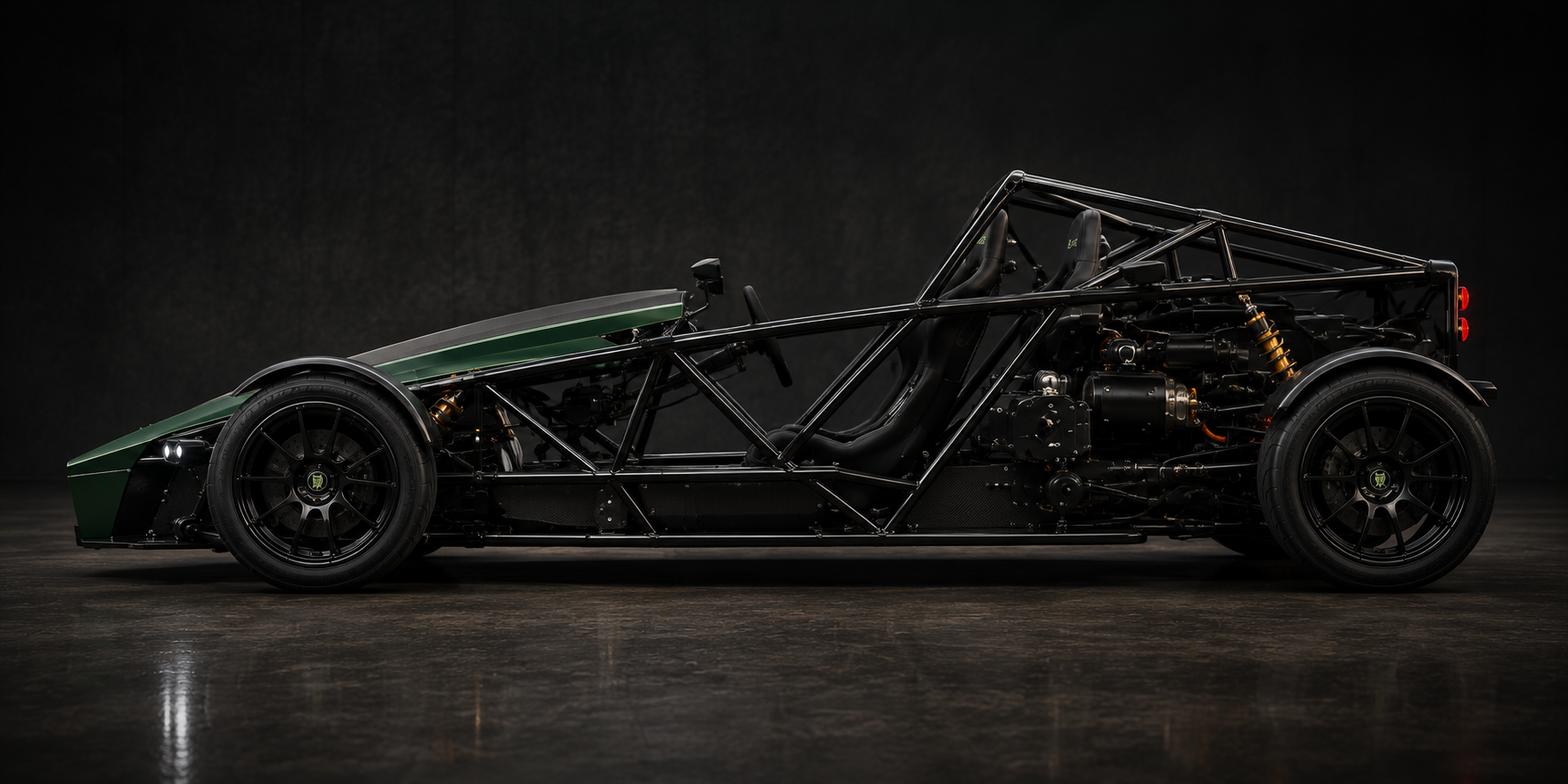
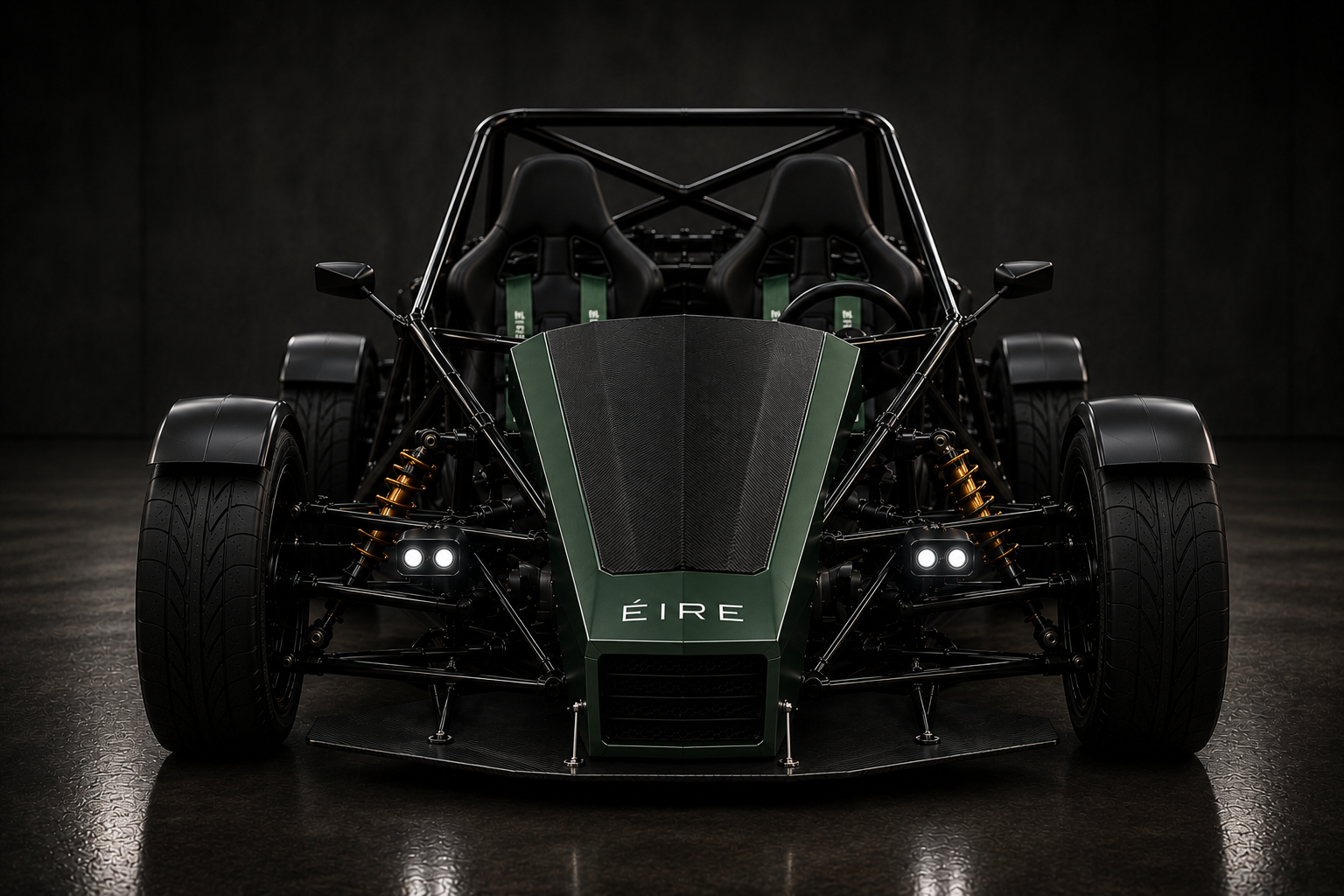
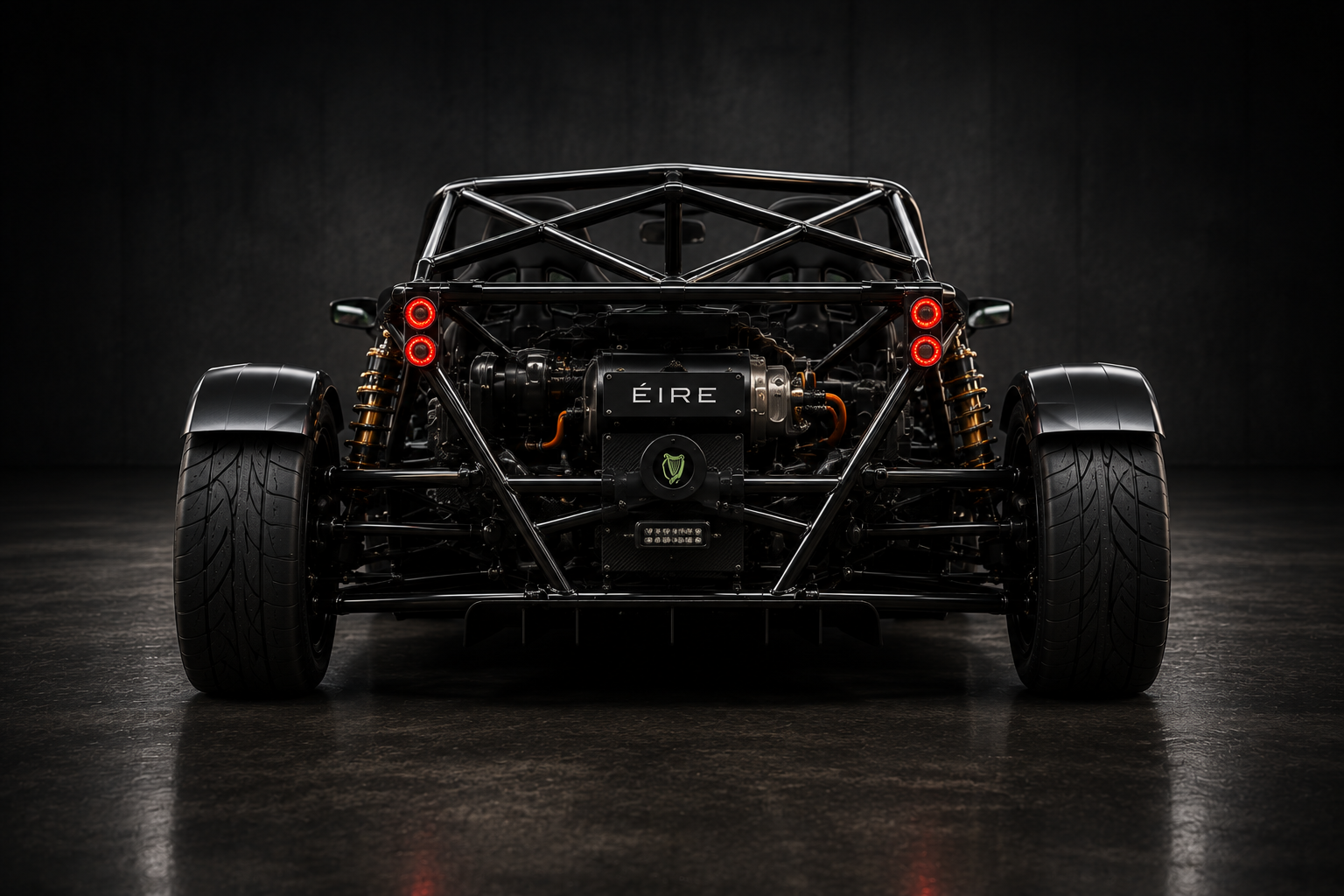
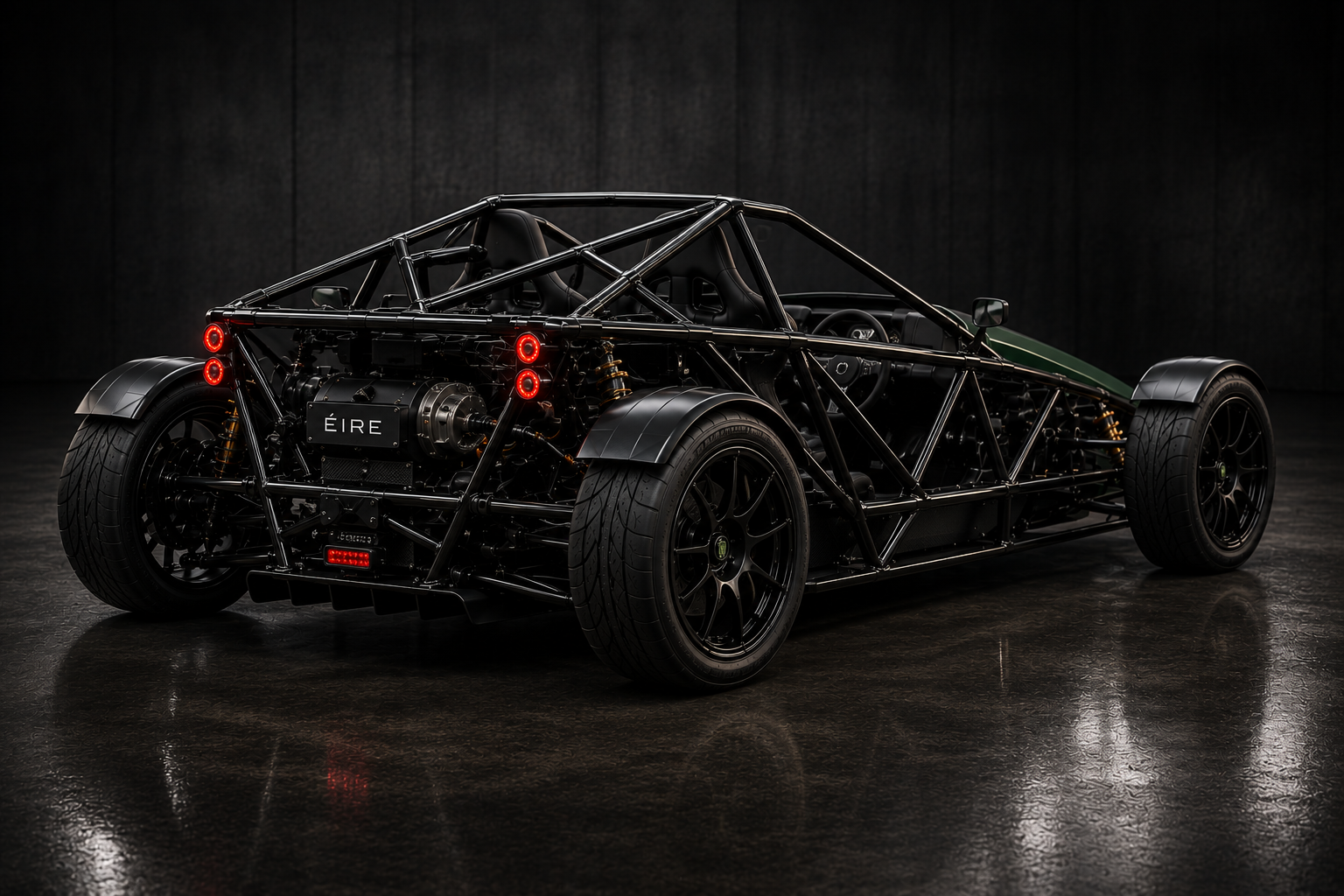
The Éire Forge takes the opposite view. Its structure is an exposed tubular steel spaceframe — an exoskeleton worn on the outside, where every triangulated tube is visible, legible and proudly on show. There is an honesty to this that a closed monocoque cannot offer: you can read the load paths with your eyes, trace the geometry of the chassis, and understand exactly how the car holds itself together. Painted in deep Irish racing green, the lattice becomes the design rather than something hidden beneath it.
There is a practical dimension, too. A visible steel structure is characterful, but it is also more straightforward to inspect and repair than a composite tub, which can demand specialist attention after a hard contact. The Forge’s construction is therefore as much a statement of intent as of style — a track car designed to be lived with, understood and maintained, not merely admired and feared. The choice of materials is a choice of relationship between car and driver.
Powertrain: Turbo Theatre Versus Instant Silence
Historically, the X-Bow has drawn its muscle from an Audi-sourced turbocharged four-cylinder — a proven, characterful engine with a hard-edged induction note and the familiar surge of forced induction. It is a thoroughly engaging unit, but it brings the traditional caveats of turbo petrol: a moment of lag as boost builds, heat and noise to manage, gears to swap, and a power delivery that arrives in a rush rather than in a line.
The Éire Forge rewrites that experience entirely. Its all-electric, rear-wheel-drive powertrain targets roughly 295 hp with the instant, linear torque that only an electric motor can deliver — no lag, no waiting, no gearshift to interrupt the thread of acceleration. With a weight target in the region of 1,800–2,050 lb and a power-to-weight figure around 6.6 lb per hp, the Forge is designed to feel ferociously immediate, its response measured in milliseconds rather than revs. A mechanical limited-slip differential keeps that torque honest as it reaches the road, sharpening corner exit and rewarding a committed right foot.
Silence changes everything about how such a car feels. Strip away the engine roar and you are left with the things drivers usually never hear — tyre slip, suspension working, the air moving past an open cockpit at speed. It is a different kind of intensity to the X-Bow’s mechanical fury, but no less visceral. Where the Austrian assaults the senses, the Irish car sharpens them.
Usability, Feel and the Spirit Behind the Badge
On feel, both cars promise the raw, unfiltered communication that makes this breed so addictive — the open cockpit, the minimal mass, the sensation of sitting within the machine rather than upon it. The X-Bow’s character is shaped by its motorcycle DNA: KTM’s “Ready to Race” ethos translates into a car that feels deliberately feral, a track weapon that asks much of its driver and offers theatre in return. It is madness, engineered with precision.
The Éire Forge seeks a subtly different note. It is hand-built and strictly limited, conceived as the wild, stripped-back sibling to Éire’s grand tourer, the Eden GT — the focused, lightweight counterpoint to that car’s long-legged refinement. The intent is not merely to overwhelm but to involve: instant electric response paired with a structure you can see and trust, wrapped in a quiet sense of Irish craft rather than industrial aggression. Born of Ireland. Built for the World is more than a tagline; it is a statement of where the car’s soul resides.
As a verdict, neither car is simply better — they are answers to different questions. If you crave the turbocharged theatre and proven, race-bred carbon pedigree of an established cult machine, the X-Bow remains a compelling and characterful choice. If you want something rarer — an exposed steel exoskeleton, instant silent torque and the hand-built spirit of a new Irish marque — the Forge offers a vision of the extremist track car for a different age. One is the brilliant culmination of an idea; the other, the beginning of one.