The Concept: Lightness Made Visible
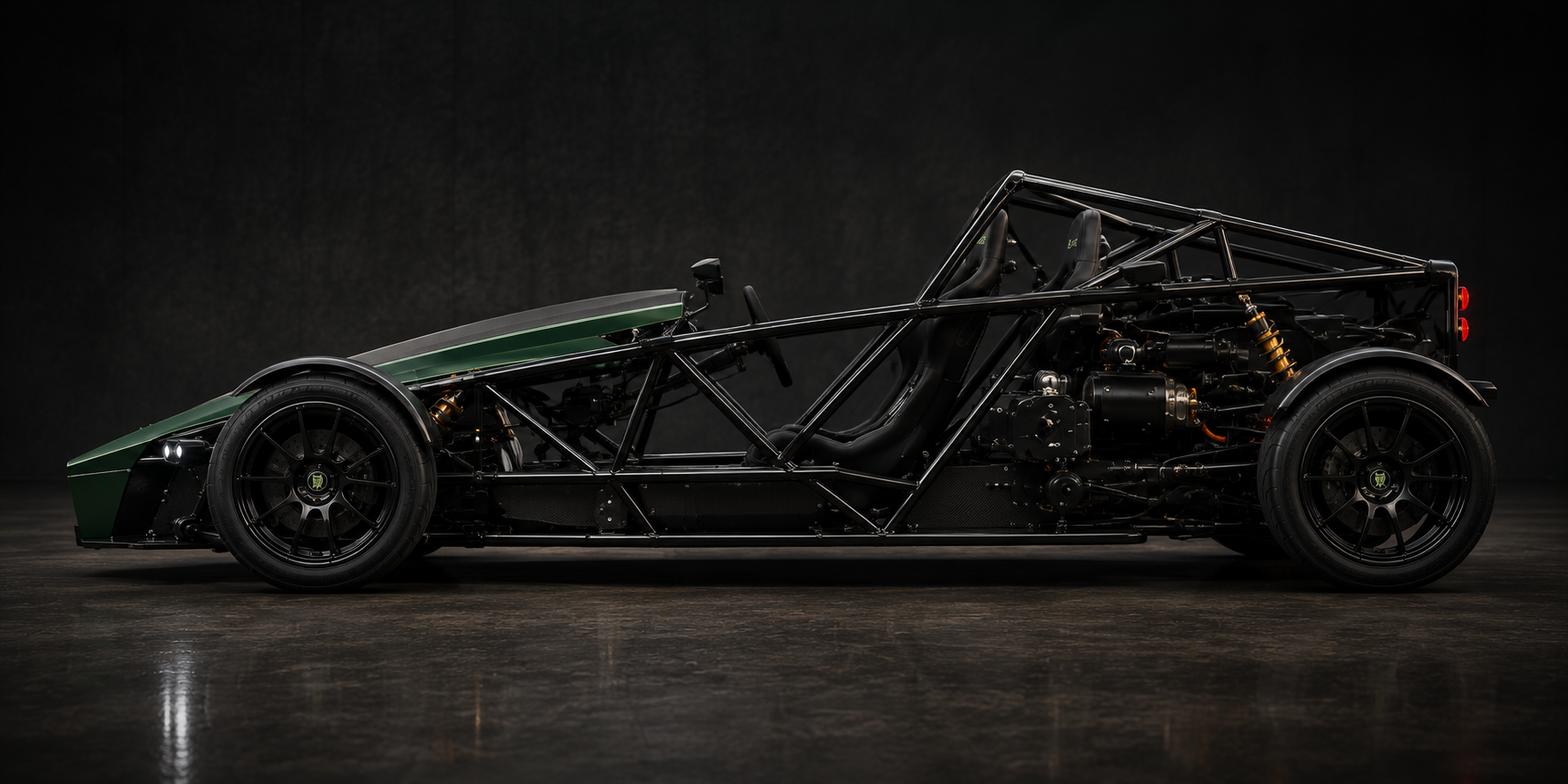
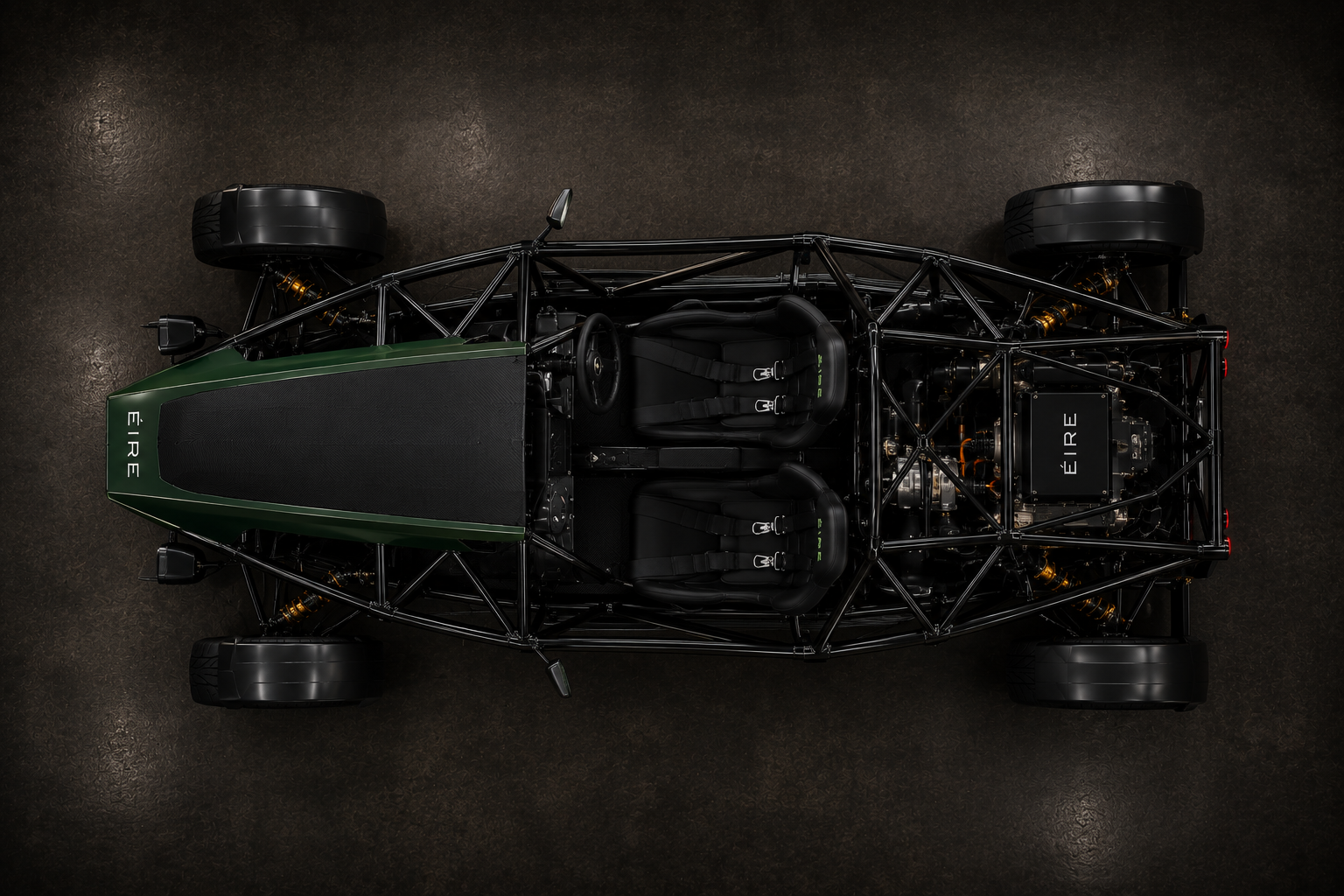
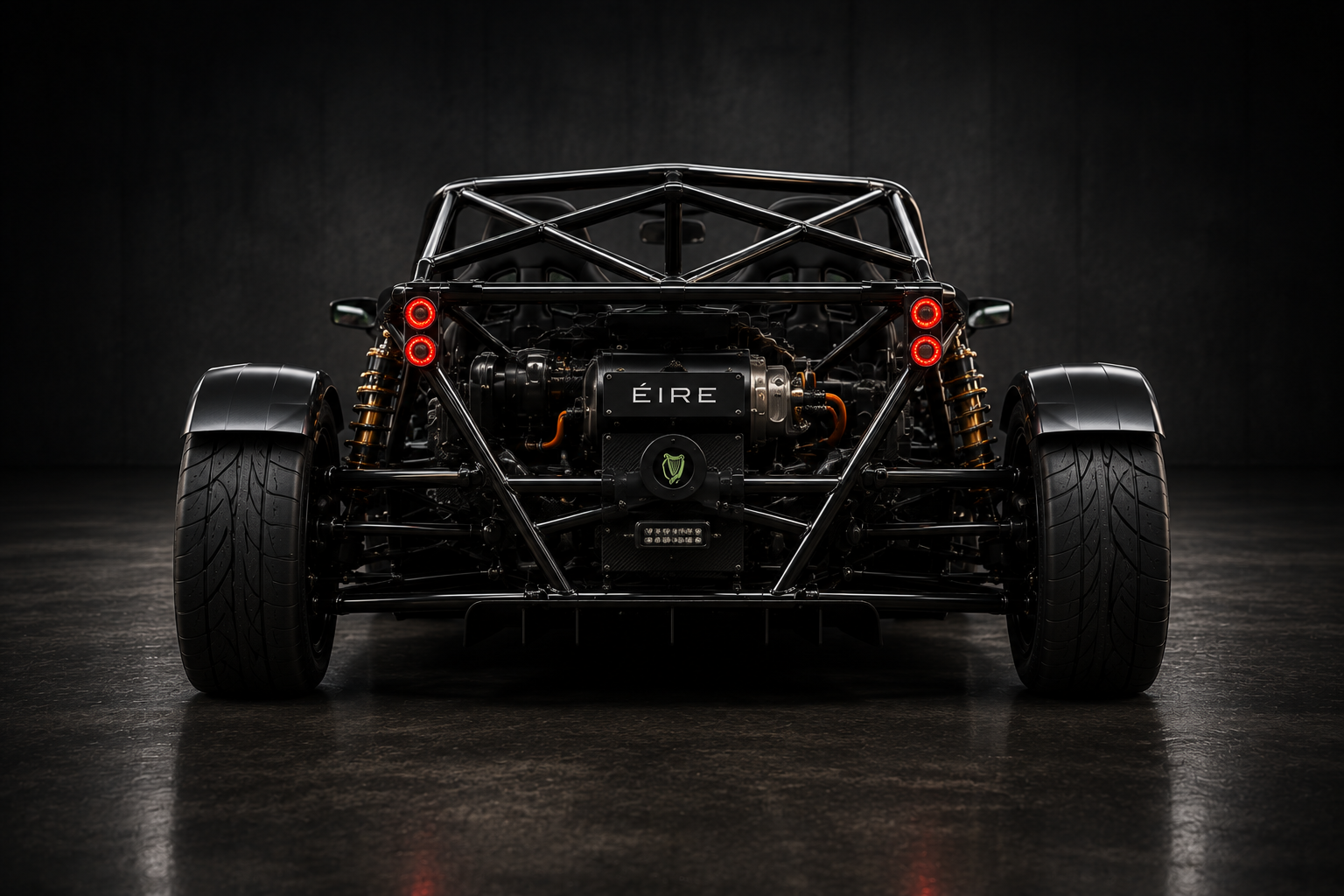
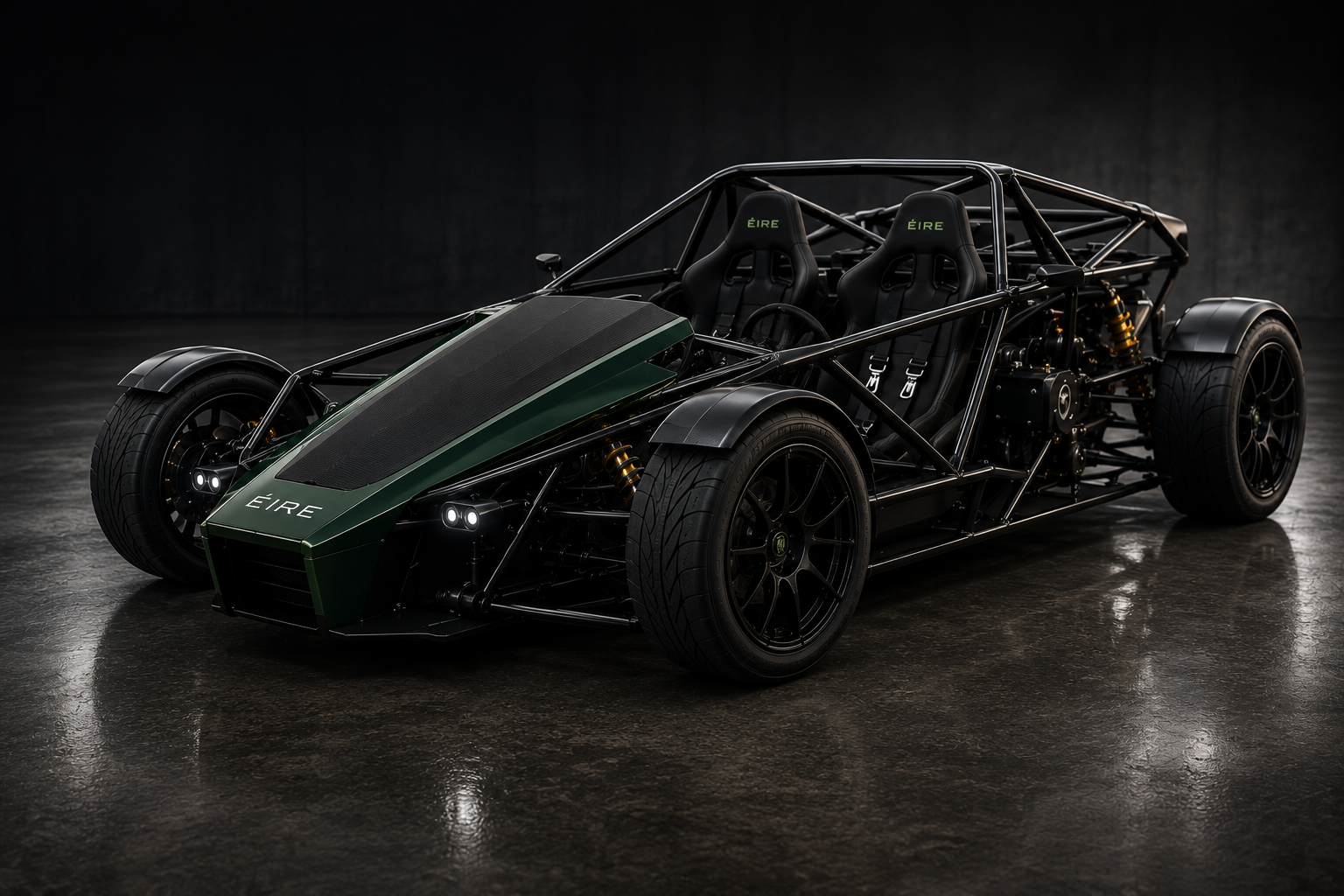
The Forge is, at first glance, a machine reduced to its skeleton. Where most cars hide their structure beneath panels and paint, the Forge wears its exposed tubular steel spaceframe as the design — an exoskeleton that is both the chassis and the statement. There are two seats, an open cockpit and very little else. This is deliberate. Every element that remains has earned its place; everything superfluous has been left on the workshop floor.
The discipline here is obsessive lightness. With a weight target of roughly 1,800 to 2,050 lb, the Forge is designed to feel less like a vehicle you operate and more like an instrument you play. Lightness sharpens everything — braking, turn-in, the way the car settles mid-corner — and it is the single quality that defines this entire breed of car. The Forge is engineered around that truth rather than apologising for it.
It is, in every sense, an honest machine. Nothing is concealed; the engineering is the aesthetic. That candour extends to how it drives — there is no electronic theatre smoothing over the experience, no synthetic drama layered on top. What you feel is what the car is actually doing, communicated directly and without translation.
The Electric Heart: Instant Torque, Near-Silent Violence
For all its mechanical purity, the Forge’s defining innovation is what powers it. This is an all-electric track car — rear-wheel drive, with a target of around 295 hp delivered through a mechanical limited-slip differential. The combination is unusual and intentional: the immediacy of an electric motor, married to the kind of mechanical, driver-rewarding hardware that purists demand.
Electric power changes the character of a car like this profoundly. Torque arrives the instant you ask for it — no waiting for revs to build, no gap between intention and response. In a machine this light, that immediacy borders on startling. Against a power-to-weight figure of roughly 6.6 lb per hp, the Forge is designed to deliver acceleration that feels less like building speed and more like being summoned to it.
Then there is the sound — or the deliberate absence of it. Where this class of car has traditionally announced itself with mechanical fury, the Forge approaches with near-silent violence. The mechanical limited-slip differential ensures the rear axle still behaves like a driver’s tool, putting power down with composure and letting the car be steered on the throttle. It is the analogue feel of a great track car, wired into an electric drivetrain.
The Philosophy: Purity, and an Irish Soul
Strip away the specification and the Forge is an argument about what a driver’s car should be. The philosophy is purity — the conviction that lightness and directness matter more than numbers on a brochure, and that the most rewarding cars are the ones that ask the most of the person behind the wheel. The Forge is unapologetic on this point. It is not built to flatter; it is built to involve.
That conviction is wrapped in something distinctly national. The Forge is hand-built in strictly limited numbers and finished in a signature Irish racing green — a nod to a heritage of motorsport colour and to the country that produced it. Éire’s tagline, “Born of Ireland. Built for the World.”, is not marketing flourish so much as a statement of intent: a car conceived with Irish engineering and craft, made to stand among the best anywhere.
The result is a machine with a clear point of view. In an era of ever-heavier, ever-more-insulated performance cars, the Forge moves resolutely in the opposite direction — toward less weight, less noise pollution and more genuine connection. It is a halo car in the truest sense: a distillation of everything Éire believes a driving machine should be.
The Tradition: Atom, X-Bow, and an Electric Successor
The Forge does not arrive without ancestors. It belongs to a small and revered tradition of exposed-structure, ultra-light track cars — machines built around the radical idea that the best way to go faster is to weigh less. The Ariel Atom, with its skeletal tubular frame and complete disregard for convention, is widely regarded as the car that defined the genre for a modern audience. The KTM X-Bow pushed the same philosophy further still, pairing an exposed structure with composite construction and unflinching track focus.
What unites these cars is honesty. None of them hides what it is; all of them prize the driver above comfort, refinement or status. The Forge steps directly into this lineage — but it does so as the electric chapter. Where the Atom and X-Bow are widely associated with the sound and fury of combustion, the Forge offers the same elemental experience with an entirely different heart, proving that the philosophy of lightness translates intact into the electric era.
That is the Forge’s quiet ambition: to honour a tradition it clearly respects while moving it forward. It is not a replica of the cars that inspired it, nor a nostalgic tribute. It is what comes next — the open-cockpit track car, reimagined for an age in which performance and electrification are no longer at odds.
The Forge and the Eden GT: Two Expressions, One Philosophy
The Forge does not stand alone in Éire’s thinking. It is the focused, stripped-back sibling to the Éire Eden GT — the marque’s grand tourer — and the two cars are best understood as a pair. They share a philosophy of lightness, purity and electric power, but they express it in opposite directions. The Eden GT channels that philosophy into refinement, range and long-distance grace; the Forge channels it into rawness and immediacy.
Think of them as two answers to the same question. Where the Eden GT wraps you in a cockpit and carries you effortlessly across a continent, the Forge removes the cockpit altogether and demands your full attention for every corner. Neither is more authentic than the other; each is a complete expression of what Éire is, simply tuned to a different temperament. Together they describe the breadth of the brand — civility at one end, intensity at the other.
This is why the Forge matters beyond its own specification. It is the sharpest articulation of Éire’s engineering values — the car that shows, in the most uncompromising terms, what the company believes a driving machine can be. The Eden GT may be the one you live with; the Forge is the one that defines the ideal both cars are reaching toward.