The Objection: Weight Is the Enemy
Ask any racing driver what ruins a car on track and “mass” will be near the top of the list. Weight blunts braking, loads the tyres, scrubs speed through direction changes and punishes every transition. The classic charge against the electric track car is simple: the battery is heavy, so the car is heavy, so the car cannot truly dance the way a featherweight combustion sports car can.
There is real substance here. A large battery pack — the kind needed for long motorway range — can weigh several hundred kilograms on its own, and that mass has to be carried everywhere, all the time. The result, in many road-going EVs, is a kerb weight well beyond two tonnes. On a circuit, that translates into longer stopping distances, more heat through the brakes and tyres, and a car that can feel inert when you ask it to change line quickly.
The second honest concern is thermal. Sustained, hard track use generates a great deal of heat in the battery and motors, and an EV that has not been engineered for repeated hot laps may reduce its own power to protect itself. A car that is searingly quick for one lap and then steps back is not a track car in the truest sense. These are the trade-offs anyone serious about the format must acknowledge head-on, rather than wave away.
The Counter-Case: What Electric Does Brilliantly
Now the other side of the ledger, which is more compelling than sceptics often allow. An electric drivetrain offers something combustion simply cannot match: instant, perfectly metered torque. There is no turbo lag, no waiting for revs, no gearbox hunting for the right ratio mid-corner. Squeeze the throttle and the response is immediate and linear — a gift when you are balancing a car on the exit of a bend.
That precision runs deeper than feel. Electric torque can be controlled with extraordinary speed and accuracy, which makes throttle modulation cleaner and traction management far more nuanced. Floor-mounted batteries, for all their mass, sit low in the structure and pull the centre of gravity down toward the road — and a low centre of gravity is one of the most valuable traits a track car can have. Done well, it gives flat, planted cornering that flatters even quick hands.
Crucially, going electric does not mean surrendering mechanical purity. A driven axle can still run a mechanical limited-slip differential, putting power down through both wheels and rewarding deliberate, committed driving. Pair instant torque with a real LSD and precise torque control, and you have the ingredients of genuine driver engagement — not merely point-and-squirt acceleration, but a car you work with through a corner.
The Real Answer: Build the Whole Car Light
Here is the insight that resolves the debate. The problem was never “electric” in the abstract — it was the assumption that an electric car must carry a vast battery. Remove that assumption and the calculus changes entirely. If you are designing for the track rather than the motorway, you do not need maximum range. You need just enough energy, packaged as lightly as possible, in a car built around lightness from the first line on the page.
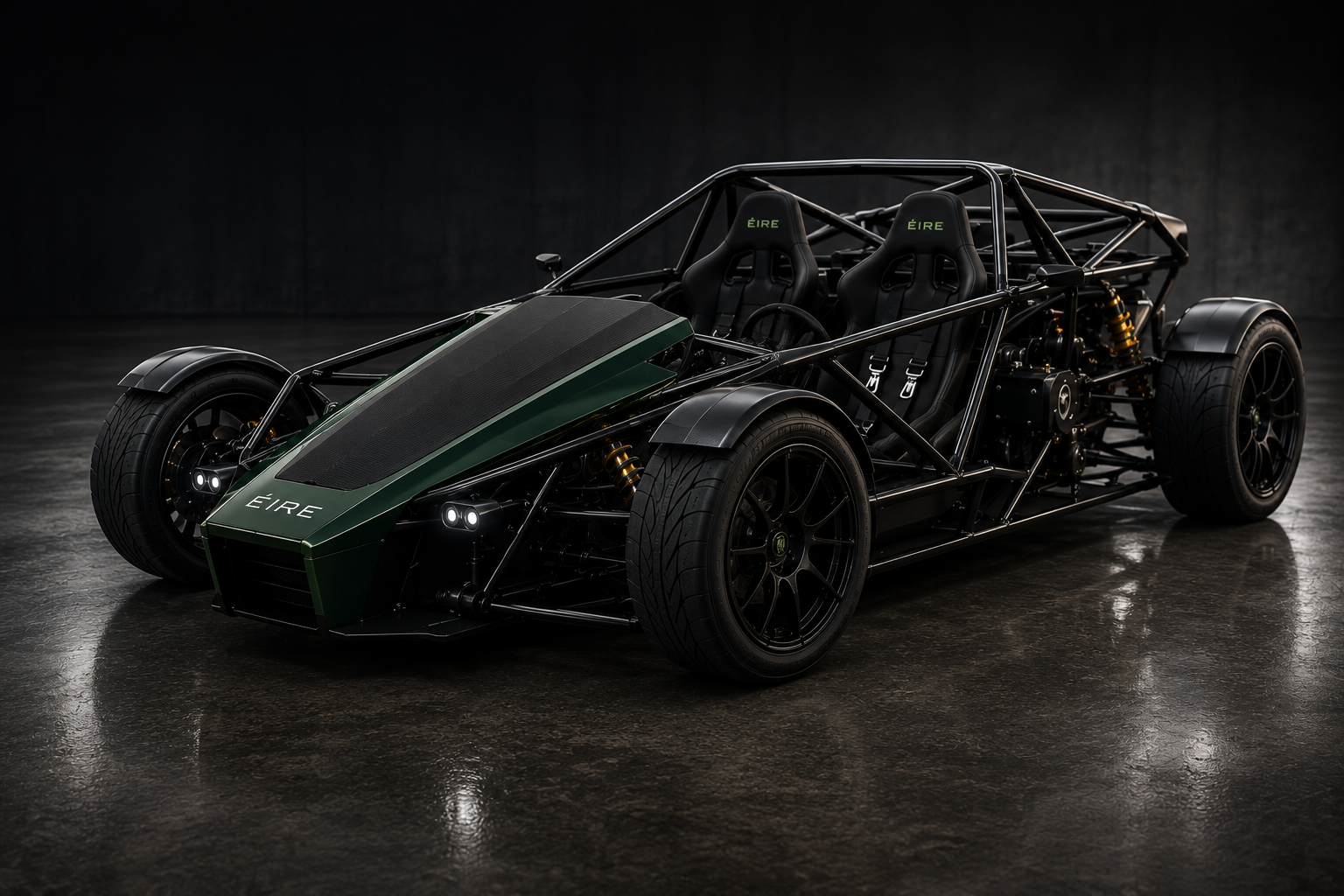
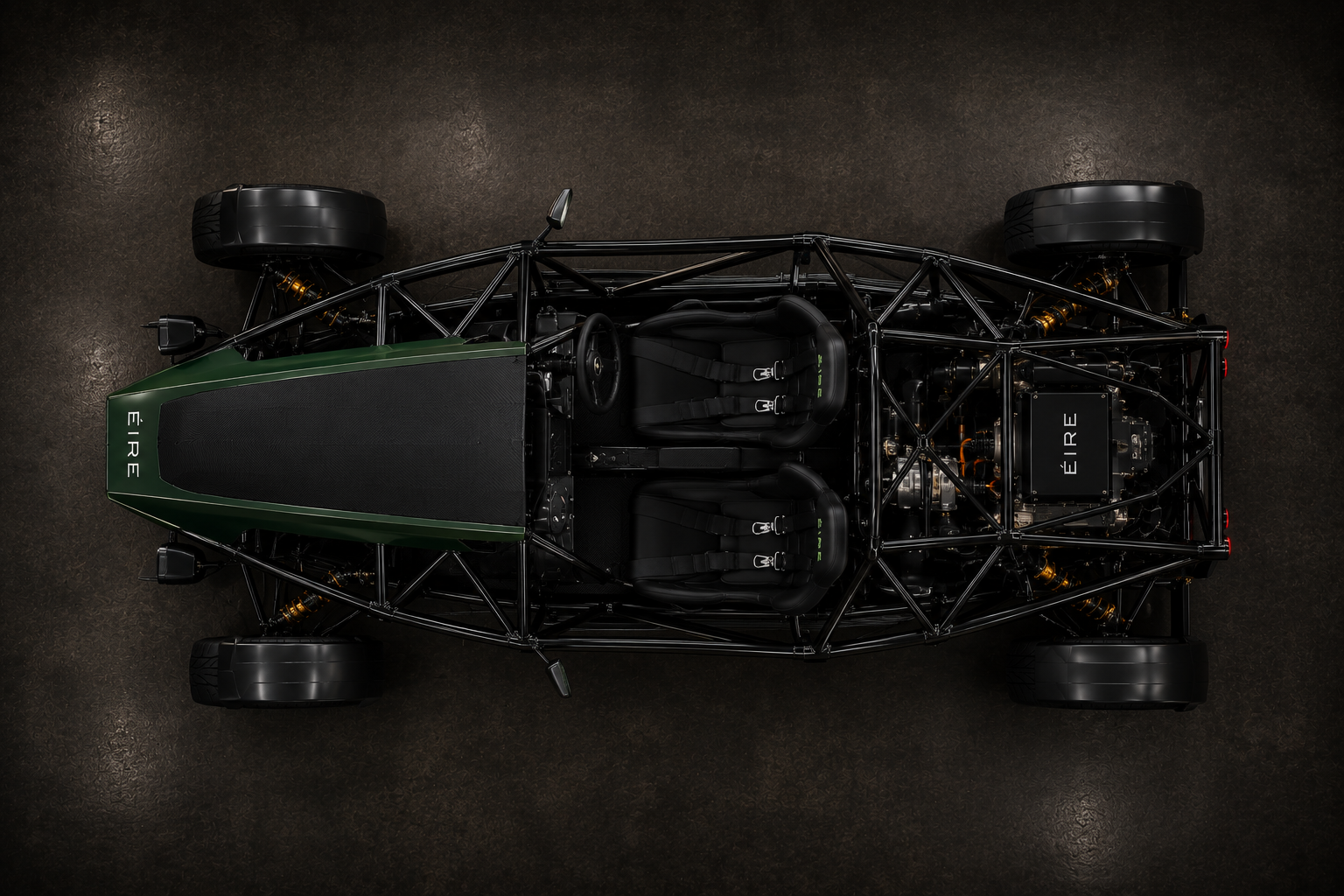
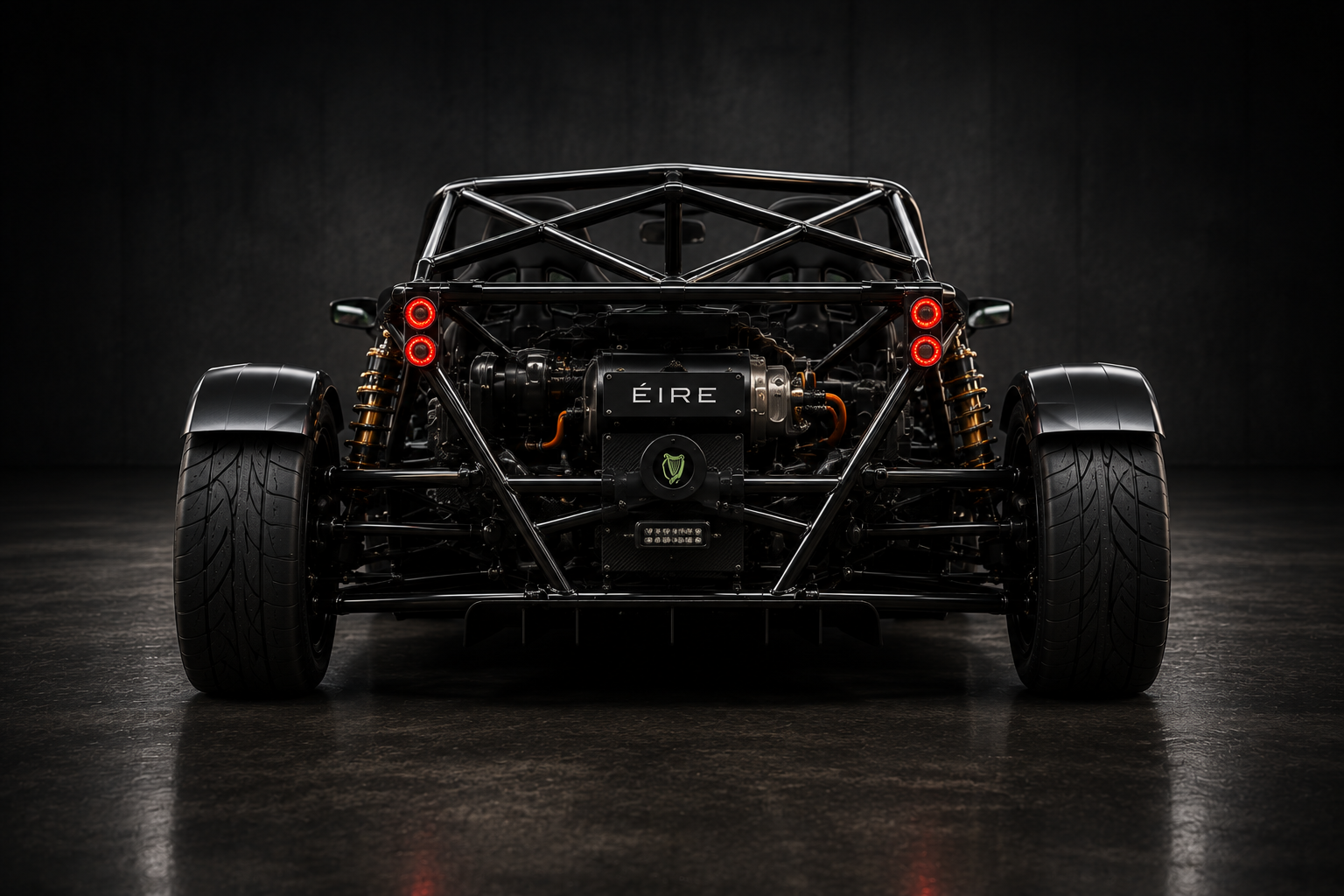
That is precisely the philosophy behind the Éire Forge Mk I. It is conceived as an open-cockpit, two-seat electric track car wrapped around an exposed tubular steel spaceframe — an honest exoskeleton with nothing hidden and nothing surplus. The design intent targets a weight of roughly 1,800 to 2,050 lb, with a modestly sized battery focused on track use rather than range-chart bragging rights. As the car remains in development these are targets rather than promises, but the direction is unambiguous: keep the whole car light, and the battery’s mass stops being a liability.
With a rear-wheel-drive layout, around 295 hp on tap and a power-to-weight figure in the region of 6.6 lb per horsepower, the Forge is engineered to feel alert and alive rather than merely rapid. Instant torque, a low centre of gravity and that mechanical LSD are no longer fighting against excess mass — they are working with a chassis light enough to exploit them. This is how an electric track car sidesteps its own oldest objection: not by arguing about it, but by refusing to be heavy in the first place.
Thrilling and Pure, Not Just Fast
The deepest fear among enthusiasts is not that electric cars are slow — everyone knows they can be brutally quick — but that they are soulless, fast without involvement. A lightweight, track-focused electric car is the strongest rebuttal to that fear. Strip away the weight and you restore the very things that make a car feel alive: agility, immediacy, the sense that the machine answers directly to your hands and feet.
The Forge is intended as evidence for exactly that proposition. Hand-built in strictly limited numbers and finished in Irish racing green, it is meant to be experienced rather than spec-sheeted into submission — a car whose appeal lies in how it changes direction, how it gathers itself under braking and how cleanly it puts its power down out of a corner. Born of Ireland. Built for the World.
None of this asks you to pretend the trade-offs do not exist. A focused track battery favours track time over long-distance touring, and that is a deliberate choice, not an oversight. But for the question that started all this — can an electric track car be any good? — the honest answer is yes, provided it is built light and built with intent. The Éire Forge Mk I is designed to be precisely that kind of answer.