The Creed That Still Defines the Fast Car
Colin Chapman, the founder of Lotus, gave the sports car its most enduring article of faith in six words: ‘simplify, then add lightness.’ It sounds almost like a paradox — you cannot, after all, add an absence. But that is precisely the point. Chapman understood that lightness is not a component you bolt on at the end; it is the consequence of a thousand earlier decisions to do without. Remove a bracket here, a redundant panel there, a comfort nobody asked for, and the weight you never added is the weight you never have to overcome.
What makes the creed radical is its order of operations. Most engineering begins with a target — a horsepower figure, a luxury feature, a marketing headline — and then asks how to carry it. Chapman’s discipline reverses that. It begins by asking what the car genuinely needs to do, strips everything that does not serve that purpose, and only then considers what to add back. The result is a machine defined by its restraint, where every gram present has earned its place.
This is why the philosophy has outlived the man, the era and the technology that birthed it. Engines have changed beyond recognition; aerodynamics, tyres and electronics have advanced by orders of magnitude. Yet the fundamental physics that Chapman exploited has not moved an inch. A light car remains a faster, sweeter, more honest car — and any engineer who forgets that is, sooner or later, reminded by one who did not.
What Mass Steals — and What Lightness Returns
The popular imagination ties weight only to acceleration, and it is true that a lighter car accelerates harder for a given output. But that is the least interesting part of the story. Mass is felt most keenly not when you are going faster, but when you are trying to change what the car is doing — and a car is changing direction, speed or attitude almost constantly. This is where heft exacts its real tax.
Consider braking. A heavier car carries more kinetic energy at any speed, so its brakes must dissipate more heat to stop it, over a longer distance, fading sooner under repetition. Consider cornering: every kilogram resists the change of direction you are asking for, loads the outside tyres harder, generates more heat and wears the rubber faster. Consider steering feel — that delicate conversation between your fingertips and the road. A light front end telegraphs grip honestly and responds the instant you ask; a heavy one arrives at the apex a beat late, its messages muffled by inertia. Lightness does not merely make a car quicker in a straight line. It sharpens every single thing the car does.
There is a subtler dividend, too, in tyre life and balance. A lighter car is gentler on its consumables, more consistent across a long drive or a track session, and far less dependent on ever-wider tyres and ever-bigger brakes to mask its bulk. Reduce the mass and the whole car can shrink around it — smaller components, lighter unsprung weight, a virtuous spiral in which every saving enables the next. Add mass, and the spiral runs the other way.
How the Industry Got Heavy — and What Was Lost
If lightness is so plainly superior, why has the average car grown heavier with almost every generation? The honest answer is that much of the weight was added for good reasons. Crash structures save lives. Sound deadening, soft-close everything and acres of screens sell cars. Driver-assistance systems demand sensors, processors and the wiring to feed them. Batteries, for all their virtues, are dense. Each addition is defensible in isolation; it is the accumulation that quietly buries the driving experience.
The trouble is that weight added for comfort or capability is rarely subtracted again. It compounds. A heavier body needs a stronger structure, which needs bigger brakes, which need wider wheels, which add unsprung mass, which demands stiffer springs — and so a car conceived to be effortless becomes, in the hand, strangely numb. It will post impressive figures. It may even be brutally fast in a straight line. But it has lost the quality that made driving feel like a craft rather than a transaction: the sense that the machine is light enough to move with you, not merely to be commanded.
None of this is an argument against safety or progress. It is an argument for honesty about the trade. Every kilogram is a choice, and the industry has, by and large, chosen to add. A car built in deliberate opposition to that drift — one that treats each gram as a debt to be justified — feels almost shocking today, not because it does anything exotic, but because it does so little that is unnecessary.
The Éire Forge Mk I: Lightness as First Principle
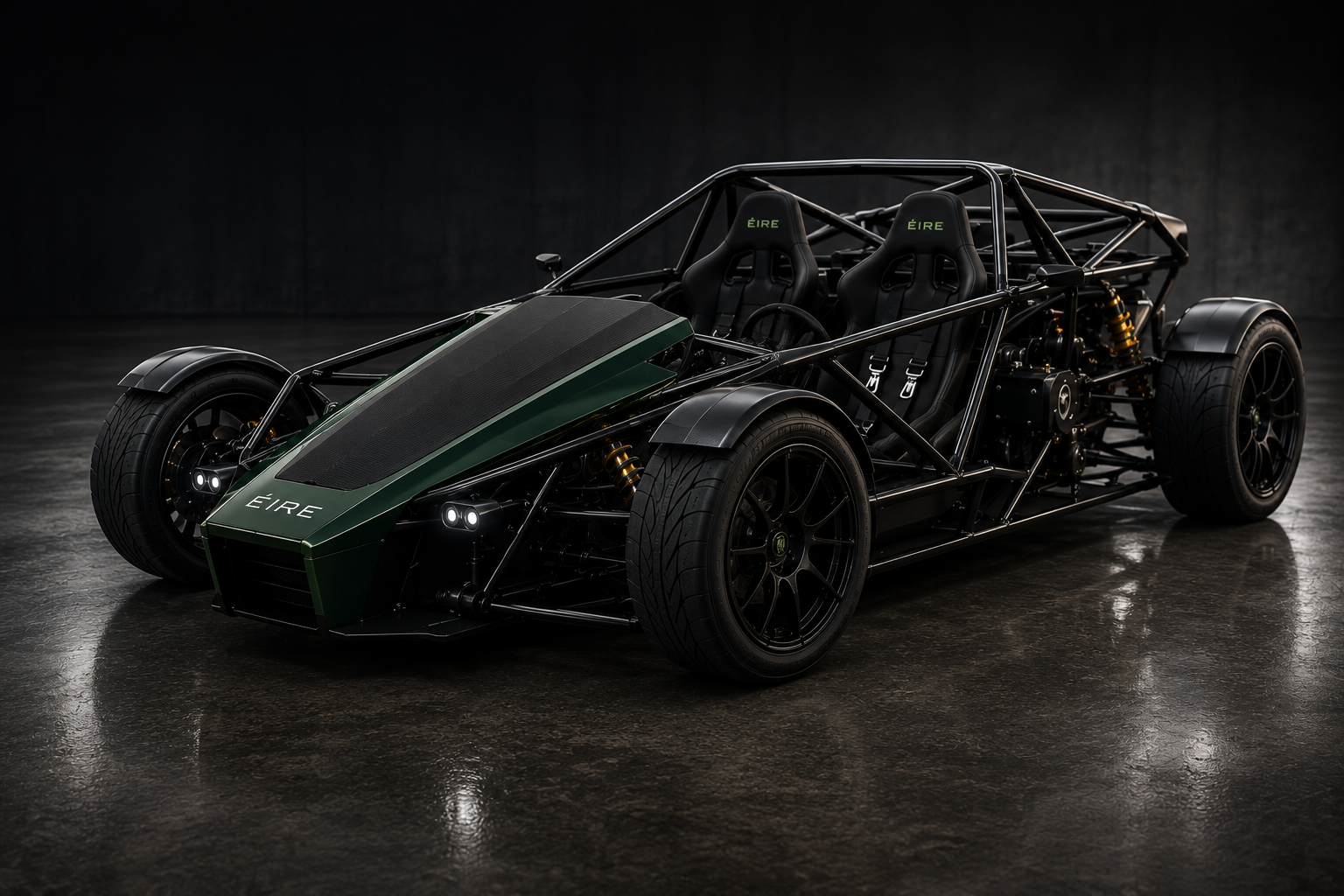
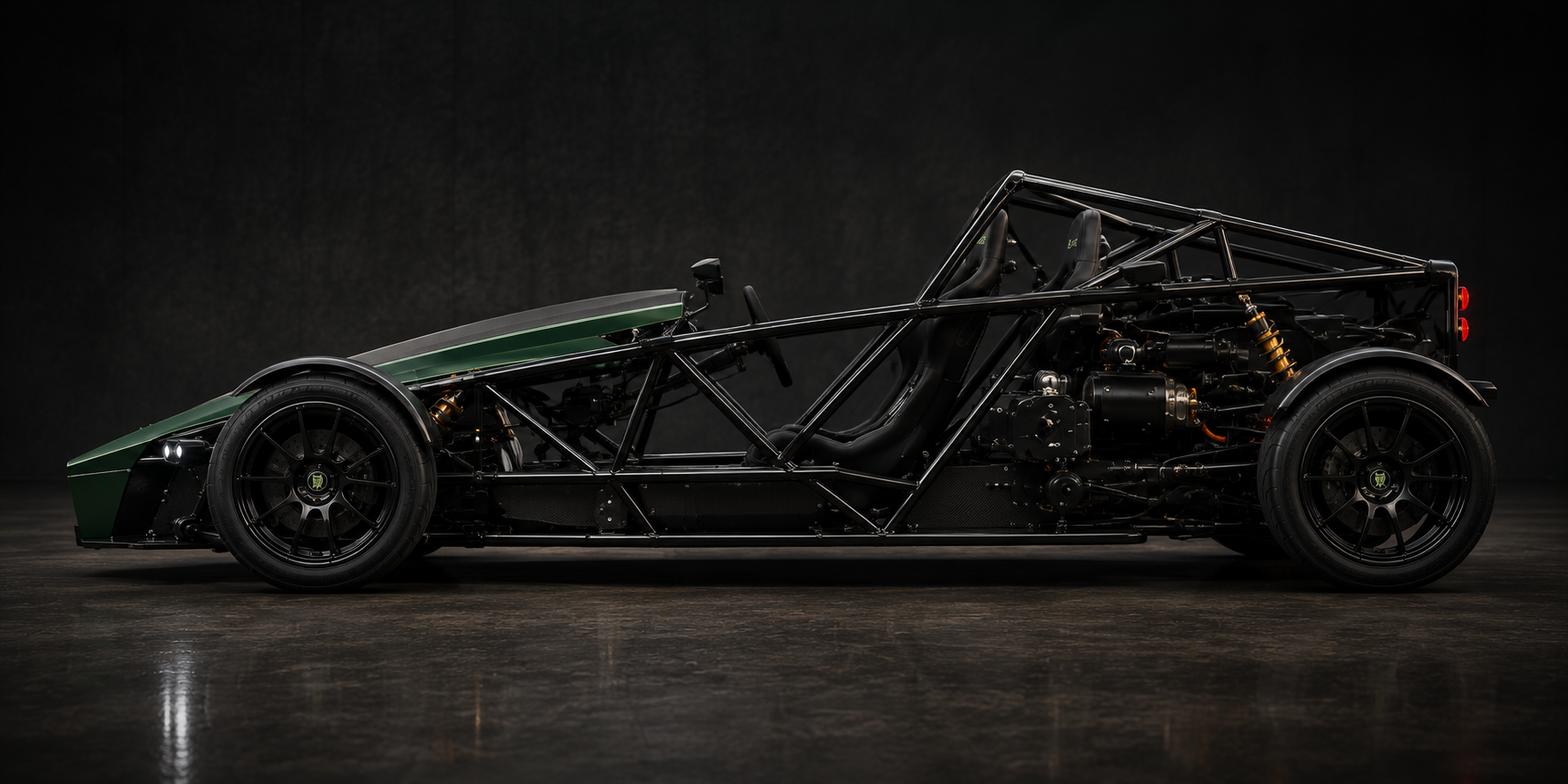
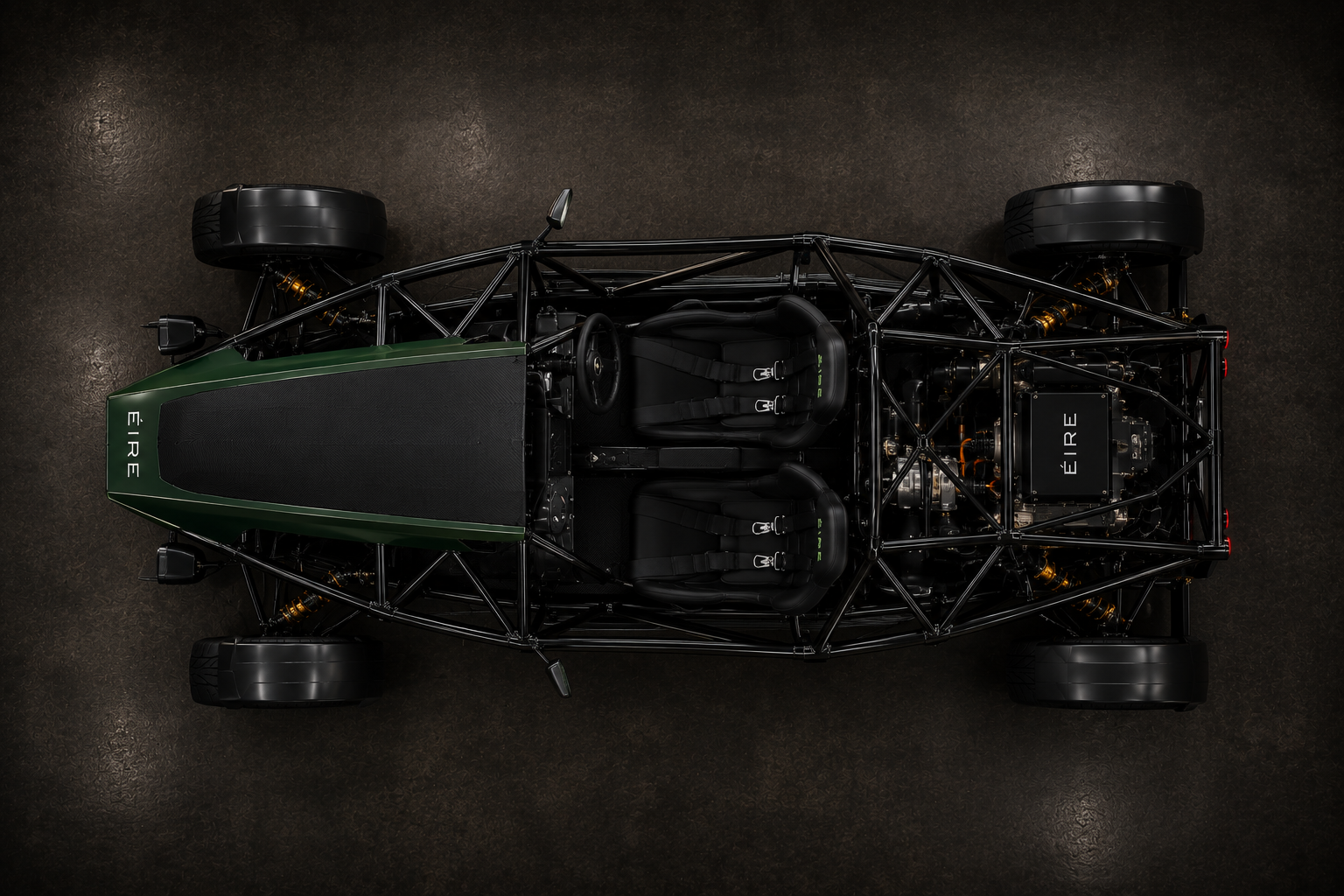
The Éire Forge Mk I exists to take Chapman’s creed at its word. It is an all-electric, rear-wheel-drive, open-cockpit two-seater built around an exposed tubular steel spaceframe — a car in which the structure is not hidden behind trim but celebrated as honest engineering. Where most performance cars are conceived around a power figure and then made to carry it, the Forge is conceived around lightness and asked to do everything else within that discipline. The target weight is intended to land somewhere in the region of 1,800 to 2,050 lb, figures that remain in development as the car is refined.
Its electric heart is deliberately measured rather than maximal: a target of around 295 hp, sent to the rear wheels through a mechanical limited-slip differential, with the instant torque only an electric motor can deliver. On paper that output is modest by the standards of the modern hot car. In the metal, paired with so little mass, it is intended to yield a power-to-weight ratio in the order of 6.6 lb per horsepower — the kind of number that makes a car feel alive at any speed, on any road, in a way that raw horsepower alone never quite manages. The point was never to win the spec-sheet arms race. The point was to feel right.
That is the quiet wager at the centre of the car: that a driver would rather have a light machine that flatters their skill than a heavy one that overwhelms it. A light car gives feedback you can act upon, rewards precision, and turns an ordinary road into something worth savouring. Hand-built in strictly limited numbers and finished in Irish racing green, the Forge is not trying to be the most powerful thing on the road. It is trying to be the most alive — and lightness, not horsepower, is how it gets there.