What Power-to-Weight Ratio Actually Is
Power-to-weight ratio is exactly what its name suggests — a measure of how much engine output a car has relative to how much it has to haul around. Horsepower on its own tells you how hard the engine pushes; power-to-weight tells you how that effort lands once it has a real car attached to it. A muscular engine bolted into something heavy can feel surprisingly ordinary, while a modest output in something feathery can feel electric. The mass is the great equaliser — or the great handicap.
There are two common ways to express it, and they are simply the same idea read from opposite ends. The first is pounds per horsepower (lb/hp): take the car’s weight in pounds and divide it by its horsepower. Here, lower is better — fewer pounds for each horsepower to move means a quicker car. The second is horsepower per ton (hp/ton): take the horsepower and divide by the car’s weight in tons. Here the logic flips — higher is better, because it means more power for every ton of mass.
Neither figure is more ‘correct’ than the other; they are two dialects of the same truth. Enthusiasts in Britain and Ireland tend to quote horsepower per ton, while lb/hp is the lingua franca of the track-day world. Whichever you prefer, the discipline is the same — never judge a car by its headline power figure until you have weighed it, quite literally, against the scales.
Why It Predicts Real-World Pace Better Than Horsepower
The reason power-to-weight matters so much is rooted in basic physics: acceleration is force divided by mass. Two cars with identical horsepower will not accelerate identically if one carries several hundred kilograms more than the other. That extra mass blunts every facet of the experience — it slows the launch, lengthens the braking distance, loads up the tyres mid-corner and dulls the change of direction. Power fights inertia, and inertia scales with weight.
This is why a lighter car so often feels faster than its raw numbers suggest, and why a heavy, high-output saloon can feel curiously inert despite an intimidating brochure. Weight is the tax levied on every input you make. A light car turns in more eagerly, settles sooner, and rewards the throttle the instant you ask — because there is simply less mass resisting your intentions.
It also explains why serious engineers treat saved weight as more valuable than added power. Adding horsepower improves one number; removing weight improves acceleration, braking, cornering and agility all at once. This is the philosophy behind every great lightweight — and the reason a stripped-back machine on a diet can run rings around something with a far larger engine and a far larger waistline.
A Worked Illustration With Familiar Reference Points
Numbers make this concrete, so consider some widely known machines — figures here are deliberately approximate and rounded, as exact weights vary by specification and measurement standard. A celebrated naturally aspirated sports car such as a Porsche 911 GT3 sits somewhere around 7 lb/hp — a benchmark for road-going sharpness. A V8 Chevrolet Corvette lands in broadly similar territory, roughly 7 lb/hp, achieving its pace through abundant power rather than minimal mass.
Step down to a typical hot hatch and the figure climbs considerably — often into the low-to-mid teens of pounds per horsepower — which is precisely why even a quick hatchback feels brisk rather than savage. Now go the other way. The famously skeletal Ariel Atom has long been quoted at around 4 lb/hp, and the result is acceleration that genuinely unsettles supercar drivers. The Atom does not achieve this with a vast engine; it achieves it by having almost nothing to carry.
Line those up and the pattern is unmistakable. The Atom is not dramatically more powerful than a hot hatch — in some forms it has less power — yet it is in another universe for response, because the mass it must move is a fraction of the hatch’s. That, in a single comparison, is the entire argument for power-to-weight over horsepower.
Where a Light Electric Car Lands — the Éire Forge Mk I
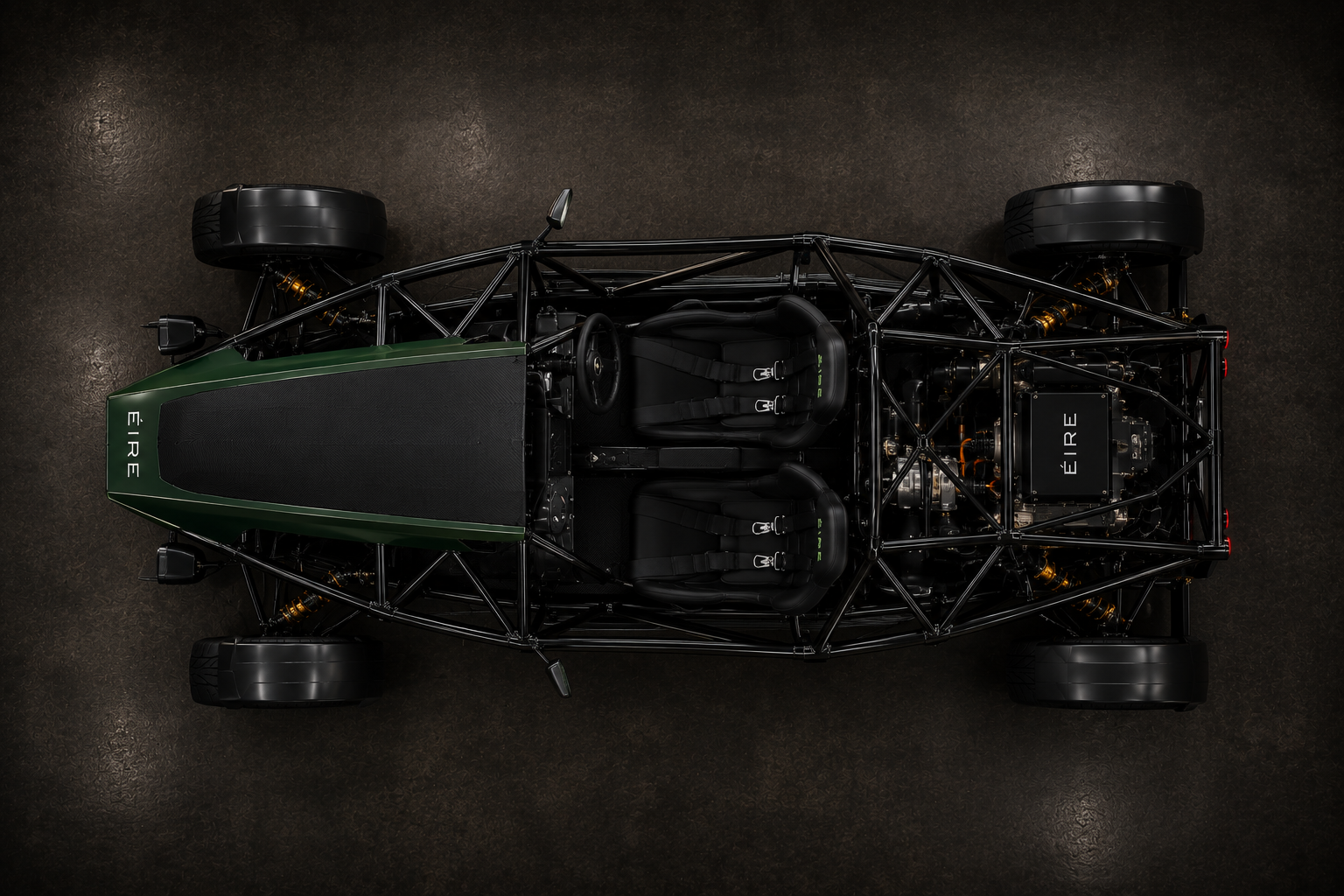
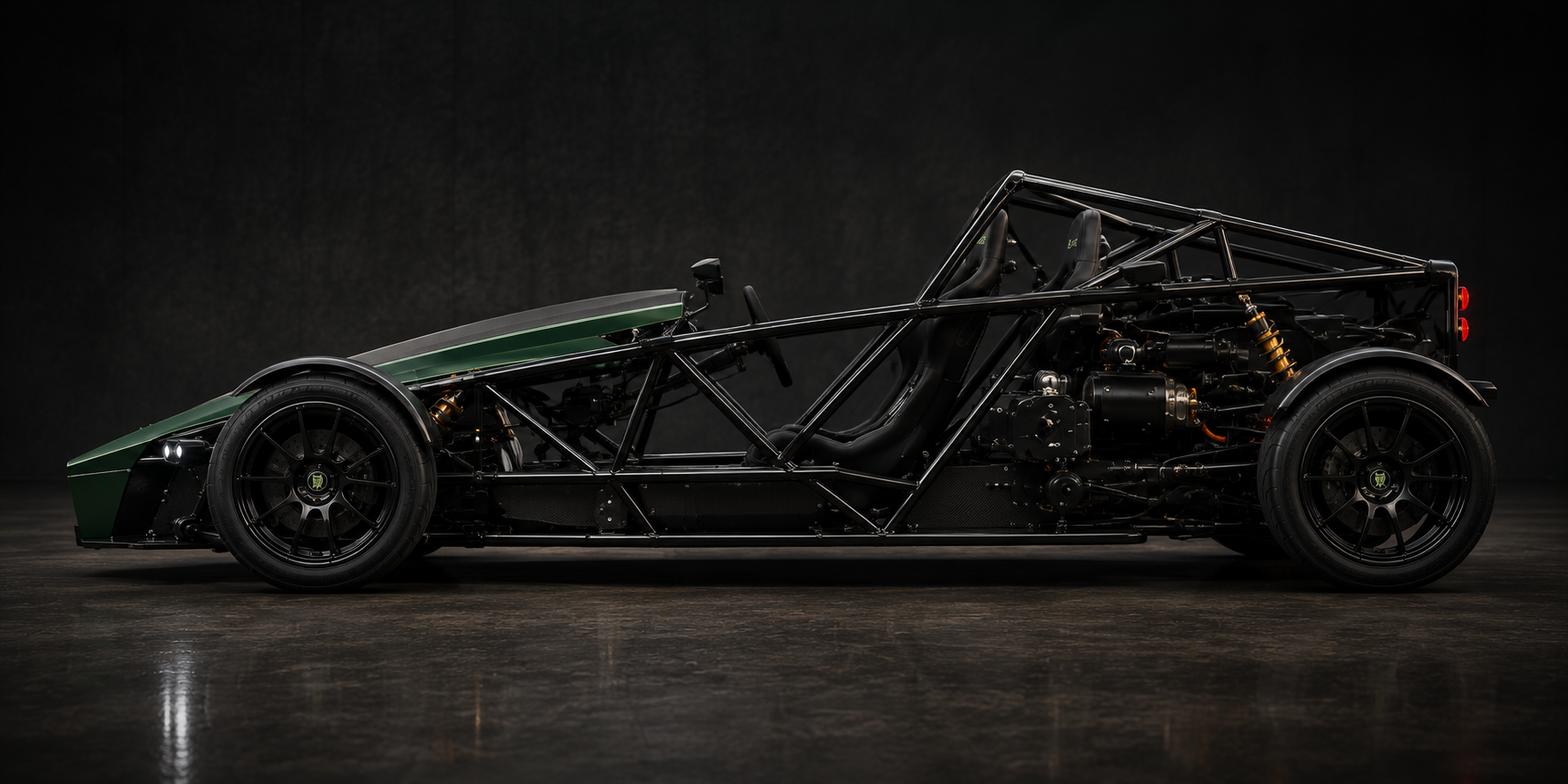
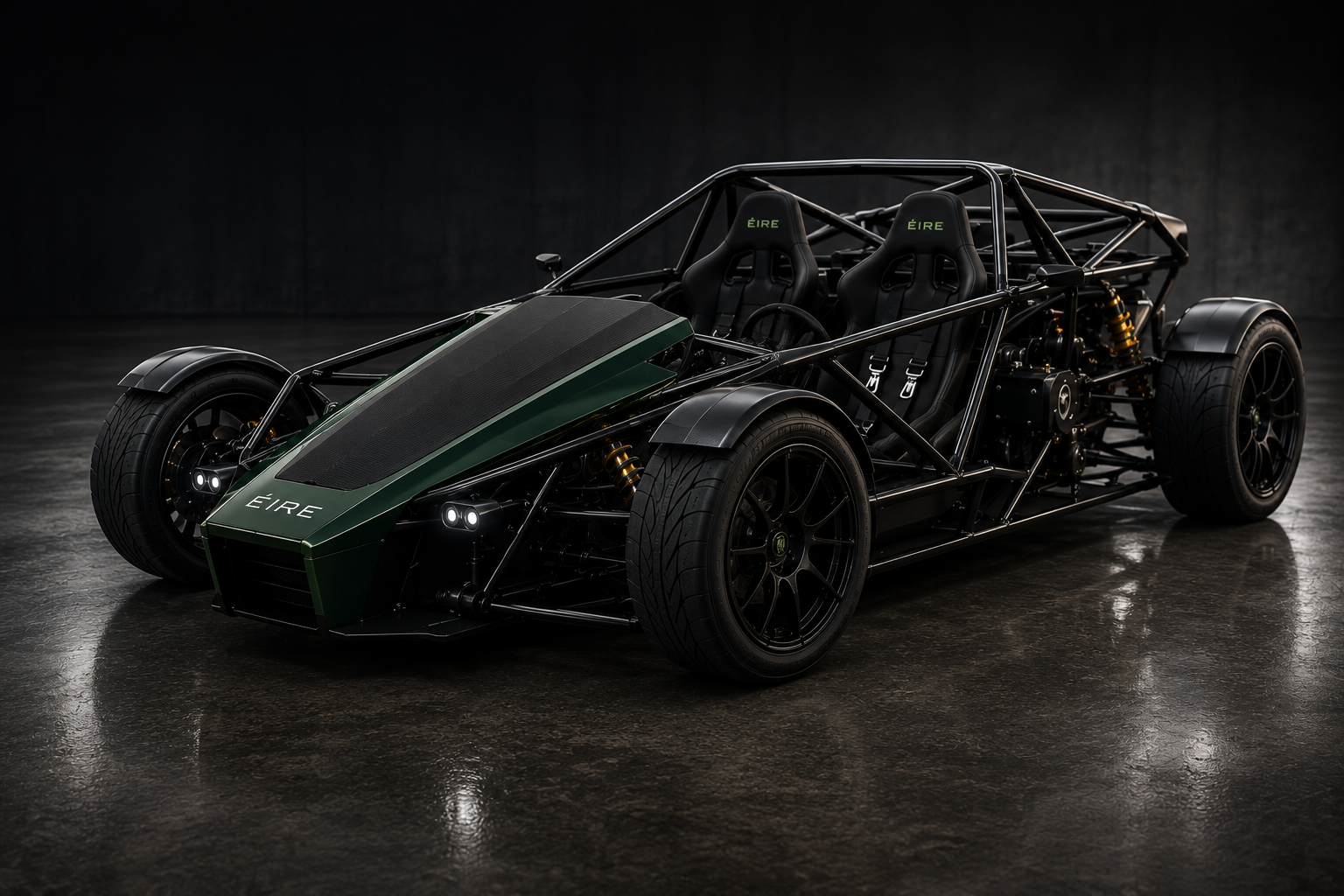
This is the context in which to read the Éire Forge Mk I. As an uncompromising, open-cockpit two-seater built around an exposed tubular-steel spaceframe, the Forge is conceived from the outset around mass — or the absence of it. The design intent targets roughly 295 hp against a weight target in the region of 1,800–2,050 lb, which works out at a power-to-weight figure of approximately 6.6 lb per horsepower. As ever with a car in development, treat these as targets rather than fixed promises.
Place that 6.6 lb/hp against the reference points above and the Forge’s intentions become clear. It is aiming to sit comfortably inside sports-car territory and well clear of anything you would call quick-for-the-road — closing meaningfully on the rarefied, track-bred end of the scale. In a car this light, a figure like that does not describe brisk progress; it describes ferocious, immediate response, the kind that compresses your chest the moment the road opens up.
There is a further dimension the headline ratio cannot fully capture. Because the Forge is all-electric and rear-wheel drive, its torque arrives instantly — no revs to gather, no gears to swap, no turbo to spool. Power-to-weight tells you the potential; instant electric torque tells you how violently that potential is unlocked. Marry a featherweight spaceframe to immediate thrust and a mechanical limited-slip differential, and you have a car engineered to feel less like accelerating and more like being fired — the purest expression of why power-to-weight, not horsepower, is the number that truly matters.